Email Etiquette for Students: How to Write Clear, Professional Emails
Emailing a professor, adviser, teacher, or school office does not require stiff or complicated language. A good student email simply makes it easy for the recipient to understand who you are, why you are writing, and what you need.
That usually means using a clear subject line, an appropriate greeting, a concise message, and a polite closing. These habits are useful throughout school and later when communicating with employers, colleagues, and other professional contacts.
What Is Email Etiquette for Students?
Email etiquette is the set of habits that helps written communication come across as clear, respectful, and appropriate for the situation.
Students may need to use professional email when contacting professors, academic advisers, administrators, internship coordinators, employers, or other people they do not normally communicate with as casually as friends.
Professional does not mean overly formal. You rarely need elaborate introductions or stiff language. The goal is to respect the recipient’s time while giving them enough information to respond.
Before You Email
A few quick checks before writing can save both you and the recipient unnecessary back-and-forth.
Check the Syllabus or Other Available Information
Before asking about a deadline, assignment requirement, attendance rule, office hours, or course policy, check whether the answer is already available.
Look at the syllabus, assignment instructions, course announcements, learning management system, or relevant school webpage first. If something is still unclear, you can then ask a more specific question.
Decide Whether Email Is the Right Method
Email works well for focused questions, scheduling, clarification, absence notifications, and straightforward requests.
A detailed discussion about a grade, an exam, a complicated academic problem, or several related concerns may be easier during office hours or a meeting. Northern Illinois University similarly distinguishes between questions that work well by email and issues that may be better discussed in person or by video call.
Use Your School Email When Appropriate
For academic communication, a school-issued email account is generally the most practical choice. It identifies you as a student and keeps school messages separate from personal correspondence.
If you need to use a personal account for an internship, employer, or outside organization, choose an address that looks professional and clearly identifies you.
How to Write a Professional Student Email
Most student emails can follow the same basic structure. You do not need a complicated template; you simply need to make each part of the message useful.
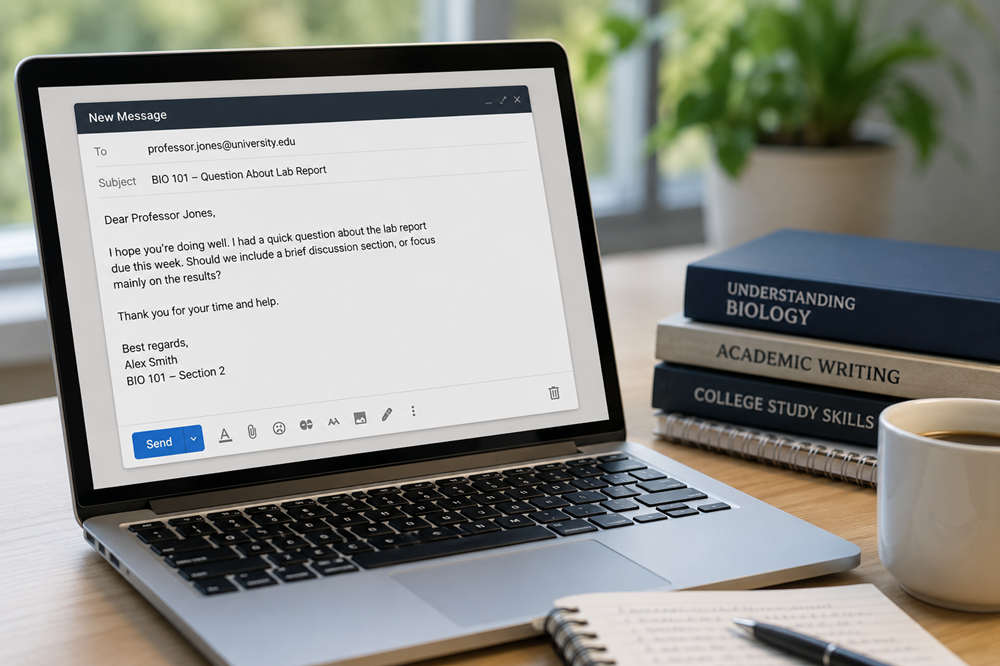
1. Write a Clear Subject Line
The subject should tell the recipient what the message is about before they open it. Avoid vague subjects such as “Question,” “Important,” or “Please Help.”
Better examples include:
- CHEM 101 — Question About Lab Report
- ECON 201 — Office Hours Meeting Request
- Tuesday Absence — Biology 110
- Question About History Essay Sources
If you are emailing an instructor, including the course name or number can be especially helpful when that person teaches several classes.
2. Use an Appropriate Greeting
Start with the person’s name and an appropriate title.
For example:
- Dear Professor Lee,
- Hello Professor Martinez,
- Good morning Dr. Carter,
If you do not know an instructor’s preference, “Professor + last name” is usually a safe starting point. If the instructor has told students how they prefer to be addressed, follow that preference.
As you get to know someone, their communication style may become less formal. Until then, it is better to avoid overly casual openings such as “Hey” when contacting a professor for the first time.
3. Identify Yourself When Needed
Professors and school staff may work with hundreds of students, so give enough information for them to place you.
A brief introduction is usually sufficient:
My name is Jordan Ellis, and I’m in your Tuesday/Thursday Introduction to Psychology class.
You may not need to introduce yourself every time if you already communicate regularly with the recipient. Include a student identification number only when it is necessary and consistent with your school’s procedures.
4. State Your Purpose Early
Move quickly to the reason for your message. The recipient should not have to read a long introduction before finding your question.
Instead of:
I’ve been looking through the assignment and thinking about a few things, and I’m not completely sure what I’m supposed to do with the sources.
Try:
Could you clarify whether the research essay requires at least three peer-reviewed sources?
The second version is easier to understand and answer.
5. Make a Specific, Polite Request
If you want the recipient to do something, make the request clear.
For example:
Would you be available during office hours this week to discuss my research topic?
This is more useful than simply writing, “I need to talk to you.”
Politeness does not require excessive apologizing. Phrases such as “Could you clarify,” “Would it be possible,” and “Would you be available” are usually enough.
6. Keep the Email Concise
Include the information the recipient needs, but avoid giving every detail surrounding the situation. Short paragraphs also make an email easier to scan.
Stanford Academic Advising recommends keeping faculty emails focused on a specific purpose and using another form of conversation when a subject requires a more involved discussion.
Professional writing also does not need to sound elaborate. Instead of:
I sincerely apologize for bothering you and hope this message does not inconvenience you, but I was wondering if you might possibly be able to explain the assignment.
A clearer version is:
Could you clarify the requirements for Part 2 of the assignment?
Clear and courteous is usually better than overly formal.
7. Close Professionally
End the message with a brief closing and your name.
Common choices include:
- Thank you,
- Best,
- Best regards,
- Sincerely,
If your course information has not already appeared in the message and is important, you can include it beneath your name.
8. Acknowledge Replies When Appropriate
Email etiquette does not end when the other person responds.
If a professor answers your question, sends something you requested, confirms an appointment, or asks you to take an action, reply when an acknowledgment is useful.
It can be as simple as:
Thank you. That answers my question.
If someone asks for something that will take longer to complete, you can also acknowledge the request and explain when you expect to have it ready.
Student Email Examples for Common Situations
The details will change depending on why you are writing. These examples show how to keep different types of student emails brief while still providing enough context.
Asking About an Assignment
Subject: ENG 102 — Question About Research Essay Sources
Dear Professor Nguyen,
I’m Maya Thompson from your Monday/Wednesday ENG 102 class. Could you clarify whether all four required sources for the research essay need to be scholarly sources, or whether one may be a reputable news source?
Thank you for your help.
Best,
Maya Thompson
Emailing About an Absence
Subject: Thursday Absence — SOC 210
Hello Professor Jackson,
I’m writing to let you know that I will be unable to attend Thursday’s SOC 210 class because of an appointment I cannot reschedule. I’ll review the posted course materials and catch up on what I miss.
Please let me know if there is anything specific I should complete.
Thank you,
Daniel Rivera
You normally do not need to provide extensive personal details when a brief explanation is enough. Follow your school’s or instructor’s attendance procedures if documentation or another form of notification is required.
Asking for an Extension
Subject: Request for Extension on History Essay
Dear Professor Patel,
I’m writing about the history essay due Friday. An unexpected family situation has significantly reduced the time I’ve been able to work on the final draft this week.
Would it be possible to submit the essay on Monday instead? I understand if the original deadline needs to remain in place.
Thank you for considering my request.
Sincerely,
Avery Brooks
Ask for the extension rather than assuming it has been granted, and contact the instructor as early as reasonably possible.
Requesting a Meeting
Subject: BIO 220 — Meeting About Research Topic
Dear Professor Chen,
I’m working on my BIO 220 research topic and would like to discuss whether my research question is narrow enough.
Would you be available during office hours Wednesday? If not, I’m also available Thursday afternoon.
Thank you,
Noah Williams
Following Up on an Earlier Email
Subject: Follow-Up — BIO 220 Meeting Request
Dear Professor Chen,
I’m following up on my email from Monday about meeting to discuss my BIO 220 research project. I wanted to check whether you might have availability later this week.
Thank you for your time.
Best,
Noah Williams
A follow-up usually does not need to repeat everything from the original message. Briefly identify the earlier request and make it easy for the recipient to respond.
Common Student Email Mistakes
Good wording can still be undermined by a small practical mistake. Watch for these common problems before sending:
- Using Reply All unnecessarily. Reply to an entire group only when everyone needs the response.
- Forgetting an attachment. If you mention an attachment, make sure it is actually included.
- Combining several unrelated requests. A message with too many separate issues can be difficult to answer clearly.
- Sending an emotional first draft. If you are upset about a grade, policy, or decision, reread the message before sending it.
- Following up repeatedly within a short period. Give the recipient reasonable time to respond.
- Submitting work through the wrong channel. If assignments must be uploaded through a course system, do not assume emailing the file counts as submission.
How and When to Follow Up
There is no single response-time rule that applies to every professor, teacher, adviser, or school office.
Start with the syllabus or communication policy. Some instructors explain how quickly they normally answer emails and whether they respond on evenings or weekends.
If no policy is given, allow a reasonable amount of time based on business days, holidays, the urgency of the question, and the recipient’s schedule. An unanswered message does not necessarily mean it was deliberately ignored.
If enough time has passed that your original email may have been overlooked, send one brief and courteous follow-up. Stanford’s faculty-email guidance notes that for faculty outreach, following up after about a week can be reasonable. Different courses and situations may call for a shorter or longer interval, so use the instructor’s stated policy when one exists.
If a genuinely urgent matter has a deadline and email is not producing a response, use the appropriate school office or another official contact method rather than sending repeated messages.
Quick Student Email Checklist
Before clicking send, check the following:
- Am I emailing the correct person?
- Does the subject clearly explain the topic?
- Did I use an appropriate greeting?
- Will the recipient know who I am?
- Is my reason for writing clear near the beginning?
- Did I make a specific request or ask a clear question?
- Is the email concise and courteous?
- Did I attach any file I mentioned?
- Did I spell the recipient’s name correctly?
- Did I proofread before sending?
- Did I include my name?
Final Thoughts
Good email etiquette for students is less about sounding formal and more about making communication easy. A clear subject, appropriate greeting, enough context, a specific request, and a polite closing will handle most academic situations well.
Learning to write concise, respectful emails is also useful beyond school. The same habits carry into internships, job applications, workplace communication, and many other situations where a clear message can make a strong professional impression.