
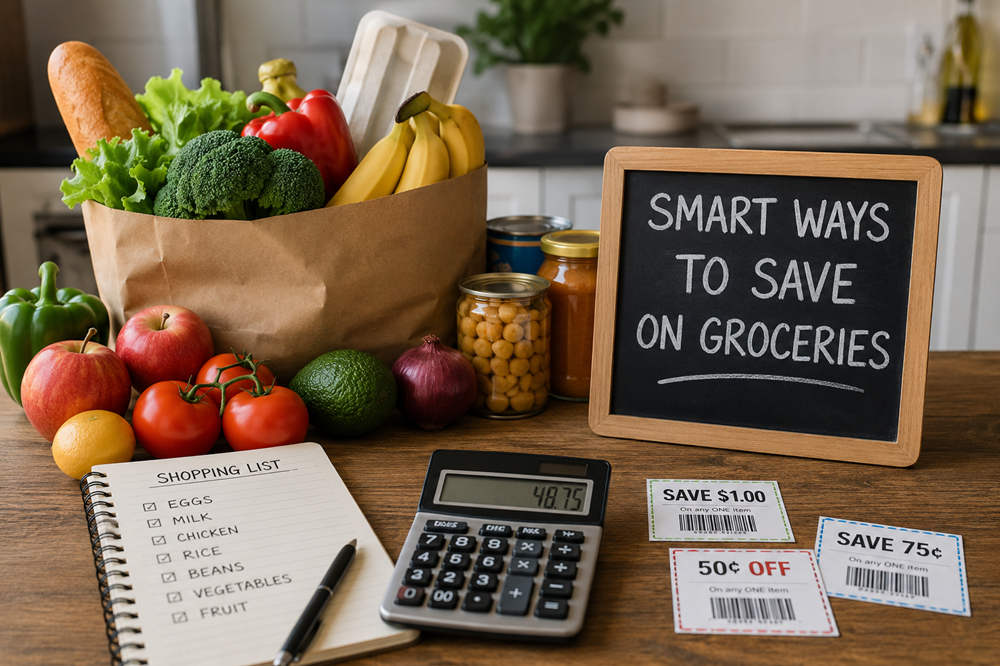
12 Smart Ways to Save Money on Groceries Without Sacrificing Good Food
Saving money on groceries does not have to mean buying the cheapest food available or cutting everything your household enjoys. A better approach is to notice where grocery money tends to disappear: food bought without a plan, packages that are not really a bargain, convenience you do not need, and ingredients that eventually end up in the trash.
A few practical changes can lower your grocery bill without making meals feel restrictive. The goal is simply to buy more intentionally and get more value from the food you bring home.
1. Start With a Grocery Budget You Can Actually Follow
Before trying to spend less, find out what you normally spend. Look at several weeks of grocery purchases and calculate a rough weekly or monthly average. When possible, separate food from toiletries, cleaning supplies, pet products, and other household items that appear on the same receipts.
Then choose a reasonable target. If you currently spend $175 a week, for example, aiming for $155 or $160 may be much more sustainable than deciding overnight that you should manage on $100.
The point of a budget is not to create another rule to feel guilty about. It gives you a baseline so you can see whether changes such as meal planning or switching brands are actually saving money.
2. Plan Meals Around What You Already Have
A useful meal plan starts in your refrigerator, freezer, and pantry.
Before choosing meals for the week, look for ingredients that need to be used. Perhaps you have half a bag of spinach, several tortillas, frozen chicken, a few potatoes, or cans of beans that have been sitting in the pantry for months. Build some of the week’s meals around those foods before buying an entirely new set of ingredients.
It also helps to choose meals that share ingredients. Bell peppers bought for fajitas might appear again in scrambled eggs. Roast chicken from dinner can become part of sandwiches or soup. A bunch of herbs can work in several meals instead of being purchased for one recipe and forgotten.
This kind of planning reduces both the shopping list and the number of half-used ingredients left at the end of the week.
3. Make a Shopping List With a Purpose Behind Each Item
Once you know roughly what you will eat, turn the plan into a grocery list.
Try to know why most items are there. Instead of buying spinach because it seems useful, know that it will go into Monday’s pasta and Wednesday’s omelet. Instead of adding several snack options on impulse, decide what your household is realistically likely to finish.
The list does not need to be rigid. If broccoli is expensive but green beans are on sale, making a sensible substitution is better than following the list blindly.
The FDA’s guidance on reducing food waste recommends planning meals, checking what is already in the refrigerator, and writing a shopping list before going to the store.
4. Compare Unit Prices, Not Just Package Prices
Two packages can have very different sticker prices without the cheaper package being the better value.
When possible, look at the unit price on the shelf label. It may show the cost per ounce, pound, count, or another standard measurement. That makes it easier to compare different package sizes and competing brands.
Unit pricing is particularly useful for foods such as cereal, rice, pasta, coffee, cheese, yogurt, canned goods, and frozen vegetables.
There is one important limit: the lowest unit price is useful only if you will consume the food. A larger package that costs less per ounce can still waste money if part of it spoils or sits unused.
5. Give Store Brands a Fair Comparison
Familiar packaging can make a product feel like the default choice, but it is worth comparing the store-brand version of everyday staples.
Products such as oats, flour, sugar, rice, canned tomatoes, beans, frozen vegetables, spices, pasta, and baking ingredients can be good places to experiment. Compare the ingredients, package size, and unit price rather than assuming the more familiar brand is automatically worth the extra cost.
You do not need to replace every favorite product. If you genuinely prefer a particular coffee, cereal, sauce, or cheese, keeping it may be worth the difference. Save where the brand matters little to you and spend where it does.
6. Use Sales to Buy What You Need, Not to Justify More Shopping
Sales can reduce your grocery bill, but only when the discounted product fits how you already eat.
Suppose chicken thighs are marked down and your household eats them regularly. Planning two dinners around them and freezing an extra package may be worthwhile. The same can be true for pantry foods you use consistently.
A promotion is less useful when it persuades you to buy something you had no intention of eating. Even a half-price product is wasted money if it sits in the cupboard until you eventually throw it away.
Coupons and loyalty offers deserve the same treatment. Look at the final price rather than the advertised savings. A discounted name brand can still cost more than the comparable store brand.
7. Buy in Bulk Only When You Will Use the Extra Food
Bulk buying works best when three things are true: the unit price is lower, you have somewhere to store the product, and your household uses it regularly.
That often makes shelf-stable staples such as rice, oats, dried beans, lentils, and pasta better bulk candidates than highly perishable foods.
Be more cautious with berries, salad greens, dairy products, bakery items, and other foods with relatively short usable lives. A large package of strawberries is not economical if you regularly throw away the last third.
Before choosing the larger size, ask yourself whether you would still want that quantity if there were no oversized-package discount. If the answer is no, the smaller package may be the smarter purchase.
8. Build Meals Around Flexible, Lower-Cost Staples
Affordable staples are especially valuable because they can work in many different meals.
Rice might become a grain bowl one night and fried rice later in the week. Beans can go into tacos, soup, chili, or salads. Potatoes can serve as a side dish, the base of a meal, or part of breakfast. Oats, pasta, lentils, canned tomatoes, and frozen vegetables can play similar roles.
The advantage is not simply that these foods can be inexpensive. It is that buying a small group of flexible ingredients gives you several meal options without requiring a completely different shopping list for every dinner.
Add meat, fish, cheese, sauces, herbs, or other more expensive ingredients where they make the biggest difference rather than making every meal depend on them.
9. Compare Fresh, Frozen, and Canned Foods
Fresh is not automatically the best value.
If your household will eat a bunch of fresh broccoli within a few days, it may be an excellent purchase. If you only need a small portion at a time, a bag of frozen broccoli may be easier to use without waste.
The same principle applies to berries, peas, spinach, corn, beans, tomatoes, and many other foods. Canned and frozen options can also be useful for keeping ingredients available when you have not recently visited the store.
When comparing formats, consider the price, usable quantity, storage life, preparation required, and how likely you are to finish the product. The cheapest shelf price does not always produce the cheapest meal.
10. Pay for Convenience Where It Actually Helps
Convenience foods often cost more per serving or unit than doing the preparation yourself. Pre-cut produce, individual snack packs, prepared side dishes, and ready-to-eat meals are common examples.
But convenience is not automatically a bad purchase.
If chopped vegetables make it realistic for you to cook after work instead of ordering takeout, the extra grocery cost may be worthwhile. Keeping a couple of easy frozen meals for unusually busy evenings can serve the same purpose.
The better question is not whether convenience costs more. It is whether you are receiving useful convenience in return. Pay for it when it solves a real problem; skip it when the extra preparation would take only a few minutes.
11. Treat Leftovers as Food You Have Already Paid For
Some of the easiest grocery savings happen after you leave the store.
The EPA estimates the cost of uneaten food at about $728 per U.S. consumer each year. Scaled to a household of four, the estimate is $2,913 annually.
You will not eliminate every bit of food waste, but making leftovers easier to use can prevent a surprising amount of purchased food from disappearing into the trash.
Give leftovers a destination when you put them away. Tonight’s dinner might already be tomorrow’s lunch. Extra chicken can become a wrap. Roasted vegetables can go into pasta or eggs. Bread that will not be used soon can often be frozen.
A simple “use first” area in the refrigerator can help too. Put foods that need attention in one visible place rather than allowing them to disappear behind newer groceries.
12. Understand Food Date Labels Before Throwing Something Away
A date printed on a package does not always mean the food automatically becomes unsafe the following day.
The FDA’s guidance on food dates and safety explains that, except for infant formula, federal law generally does not require manufacturers to place quality-based date labels on packaged foods. Phrases such as “Best if Used By” commonly relate to expected quality rather than acting as a universal safety cutoff.
That distinction should not replace basic food-safety judgment. Perishable food still needs to be refrigerated properly, stored for an appropriate amount of time, and checked for signs of spoilage or contamination.
The useful lesson is simply not to discard food automatically because you misunderstood a quality date. Proper storage and sensible evaluation can help you use more of what you buy.
If You Only Change Four Grocery Habits, Start Here
You do not need to adopt every strategy at once. Four habits account for much of the practical value in this list:
- Check your kitchen before shopping. Use what you already have to shape the next few meals.
- Shop from a plan. Give most purchases a clear purpose instead of deciding aisle by aisle.
- Compare value, not just price. Consider unit cost, quantity, quality, and whether you will actually finish the food.
- Use what you buy. Keep leftovers visible, freeze extras when appropriate, and notice which foods regularly go to waste.
Once those habits become routine, coupons, sales, store brands, and bulk purchases become much easier to use effectively.
When the Problem Is Bigger Than the Grocery List
There is a limit to how far careful shopping can stretch a household budget. If spending less means regularly skipping needed meals or being unable to buy enough food, the issue may not be something a better grocery strategy can solve.
USDA publishes food-plan cost estimates that can provide context for household food spending. Depending on circumstances, programs such as SNAP and WIC, as well as local food-assistance organizations, may also be worth checking.
Small Changes Can Make Grocery Spending More Intentional
A lower grocery bill usually comes from ordinary decisions repeated consistently rather than one exceptional coupon or extreme restriction. Plan a few meals, compare the true value of what you buy, choose quantities that suit your household, and pay attention to the food that tends to go unused.
You do not have to optimize every item in the cart. Start with the habits that fit your routine, track your spending for a few weeks, and keep the changes that genuinely save money without making everyday meals harder.