
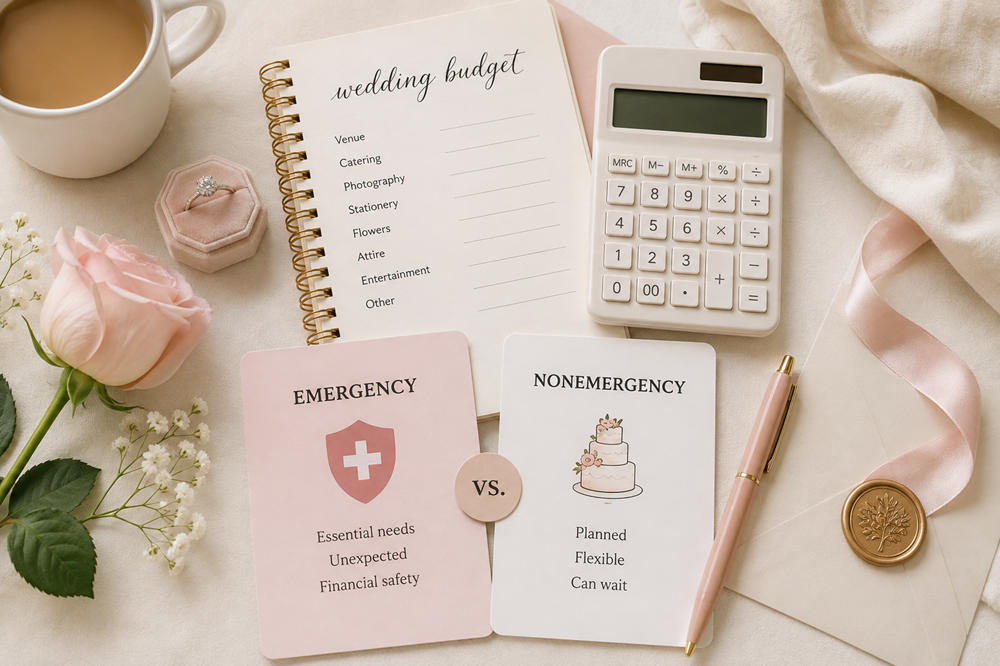
Financial Emergency vs. Nonemergency: What Counts When Planning a Wedding?
As a practical rule of thumb, a financial emergency is an unexpected expense or loss of income that needs prompt attention and affects an important financial need, such as housing, health, safety, or necessary transportation. A nonemergency expense can still be expensive, surprising, or time-sensitive, but you usually have more room to delay it, reduce it, or choose another option.
That distinction can become surprisingly blurry while planning a wedding. Deposits have deadlines, vendors have limited availability, and certain decisions can feel as though they must be made immediately. But a wedding expense can be urgent without being a true financial emergency.
Financial Emergency vs. Nonemergency: The Basic Difference
The clearest way to tell the difference is to look beyond how stressful or expensive an expense feels and ask what happens if you do not pay for it right away.
| Financial Emergency | Nonemergency |
|---|---|
| Usually unexpected and difficult to postpone | May be unexpected, but can usually be delayed, reduced, or handled another way |
| Needs relatively prompt attention | Often allows more time to decide |
| Affects an essential financial need | More often affects plans, preferences, comfort, or convenience |
| Offers few reasonable alternatives | Usually leaves room for substitutions or changes |
| May justify using money reserved for emergencies | Usually belongs in the regular budget or a separate savings goal |
The Consumer Financial Protection Bureau describes an emergency fund as money set aside for unplanned expenses or financial emergencies. It also makes an important point for everyday decision-making: an unexpected expense is not automatically a serious emergency.
In other words, surprise matters, but necessity and consequences matter more.
Examples of Financial Emergencies and Nonemergencies
Financial emergencies generally involve situations where waiting could create a serious problem or make it harder to maintain essential parts of everyday life.
Examples may include:
- A sudden loss of income that affects your ability to cover basic household expenses.
- An urgent medical expense that cannot reasonably be postponed.
- An essential vehicle repair when you rely on the vehicle to get to work or meet another necessary obligation.
- A serious home repair involving safety, heat, plumbing, electrical systems, storm damage, or another essential function.
- An unavoidable family crisis that creates necessary travel, caregiving, or similar costs with little warning.
- Failure of an essential household item, such as a refrigerator needed for food storage or a heating system during cold weather.
A nonemergency can still matter. A vacation, optional home improvement, newer phone when the current one works, entertainment purchase, furniture upgrade, or other planned purchase might be expensive without requiring emergency savings.
The same principle applies to a wedding. Premium paper, additional décor, a larger floral installation, a more expensive venue, or an upgraded menu may be meaningful parts of the celebration, but they generally remain choices rather than essential financial needs.
When a Wedding Expense Feels Like an Emergency—but Isn’t
Urgent is not the same as essential.
That distinction is particularly useful during wedding planning because the industry naturally involves deadlines. A venue may need a deposit by Friday. A photographer may have only one date left. A dress may be nearly sold out. A rental company may need your final selections sooner than expected.
Those situations create real time pressure, but they do not necessarily threaten your financial stability.
Suppose your preferred venue tells you that another couple is interested in your date and you have 24 hours to pay a deposit. You may need to make a decision quickly, but that does not mean the deposit should automatically come from money reserved for genuine emergencies.
If the venue no longer fits the wedding budget, choosing another venue may be disappointing. It is still an alternative.
The same reasoning can apply when:
- a photographer you love has only one weekend available;
- your invitation estimate is higher than expected;
- a particular wedding dress is almost sold out;
- your florist suggests a more elaborate design;
- the guest list grows beyond the number originally budgeted;
- you want to upgrade the menu, bar, entertainment, or honeymoon;
- a vendor offers an optional add-on with a short decision deadline.
In each case, you may have to decide quickly. But you can usually change the plan, reduce the expense, select another vendor, choose a simpler version, or let the upgrade go.
Four Questions to Tell Whether an Expense Is an Emergency
There will always be gray areas because one household’s essential expense may be another household’s inconvenience. A simple decision test can make those situations easier to evaluate consistently.
1. What Happens If I Don’t Pay for It Now?
Start with the consequence rather than the price.
If waiting could make your home unsafe, interrupt necessary medical care, or keep you from getting to work, the expense may need prompt attention.
If waiting means losing a particular venue, missing a sale, or using your second-choice stationery design, the consequence is different. You may be disappointed, but your basic financial needs remain intact.
2. Does It Affect an Essential Need?
Think about housing, food, health, safety, utilities, necessary transportation, and the ability to earn income.
Most wedding purchases serve a different purpose. Photography, flowers, custom invitations, specialty linens, favors, décor, premium rentals, and entertainment can all contribute to a meaningful celebration, but each can also be adjusted when the budget requires it.
3. Do I Have a Reasonable Alternative?
An expense looks less like an emergency when several workable alternatives remain.
Could you wait? Reduce the quantity? Choose another material? Select a different vendor? Simplify the design? Move money from a lower-priority wedding expense rather than increasing the overall budget?
Having options does not always make the decision easy, but it changes the financial nature of the problem.
4. Was the Expense Truly Unexpected?
Finally, consider whether you could reasonably have anticipated the expense.
Wedding deposits, attire alterations, postage, gratuities where applicable, travel, marriage-license costs, and final vendor payments can feel surprisingly large when they arrive. But when they were reasonably foreseeable, they are better treated as part of planning rather than as emergencies.
Unexpectedness is useful information, but it should not be the only test. An unexpected price increase or forgotten wedding expense can still be something you solve within the wedding budget.
Emergency Fund vs. Wedding Fund: Give the Money Different Jobs
A useful distinction is simple: wedding money is for expenses you expect to have, while emergency money is for financial shocks you cannot reasonably plan around.
A wedding fund might cover the venue, attire, invitations, postage, photography, food, flowers, entertainment, rentals, and other costs associated with the celebration.
Emergency savings have a different purpose. They provide a financial cushion when an unplanned problem affects something more fundamental.
You may also be saving for a honeymoon, future home, travel, furniture, or another shared goal. A household budget can help keep those goals visible alongside everyday expenses and emergency savings.
Whether you use separate accounts or simply track the amounts separately, giving the money different purposes can make decisions clearer. Otherwise, a wedding budget can gradually absorb savings that were originally meant to provide financial protection.
What to Do If a Real Financial Emergency Happens During Wedding Planning
A genuine financial emergency can happen at any point, including in the months before a wedding. When it does, the priority shifts from preserving the original wedding plan to protecting the parts of everyday life that need attention first.
Protect Essential Expenses First
Begin with housing, food, utilities, health needs, necessary transportation, and other essential obligations. A wedding plan can change; these needs usually have much less flexibility.
Review What Is Already Committed
Look at wedding contracts, deposits, payment schedules, and purchases that have already been made. Separating committed costs from future optional spending gives you a clearer picture of what can still be changed.
Read vendor agreements carefully before making assumptions about cancellations, postponements, refunds, transfers, or payment changes. Policies vary by vendor and contract.
Pause Optional Wedding Purchases
If an item has not been ordered and is not essential to the ceremony or an existing commitment, putting it on hold can preserve flexibility while you deal with the immediate financial problem.
Contact Vendors When Plans Need to Change
If the emergency may affect the date, guest count, services, or payment schedule, communicate with relevant vendors as early as reasonably possible. Ask what options are available under your existing agreement rather than assuming a particular accommodation will be offered.
Rebuild the Remaining Plan Around the New Budget
Once the immediate situation is clearer, decide what amount can realistically remain available for the wedding. From there, prioritize the parts of the celebration that matter most and simplify the rest.
The aim is not to preserve every original detail. It is to create a wedding plan that still works after circumstances have changed.
What to Do When the Wedding Budget Cannot Cover an Expense
Sometimes there is no financial emergency at all. The wedding budget simply cannot comfortably accommodate another expense.
That calls for adjustment rather than emergency spending.
First, Reduce the Expense Itself
Look for a simpler version before abandoning the idea entirely. With stationery, for example, changing paper, printing methods, enclosure quantities, embellishments, or finishing details may lower the total while preserving the overall look and purpose.
The same approach can work with flowers, rentals, décor, menus, attire, and other flexible categories.
Next, Reprioritize Within the Existing Wedding Budget
If a new expense matters more to you than something already planned, consider moving money between categories instead of automatically increasing the overall budget.
A couple who cares deeply about photography, for example, might choose simpler décor. Another couple may prioritize food and reduce spending elsewhere. There is no universal hierarchy that every wedding has to follow.
Look at Costs Connected to Guest Count
Guest count can influence several expenses at the same time, including catering, beverages, rentals, stationery, favors, and sometimes venue requirements.
Changing the guest list is not always practical or desirable, particularly after invitations have been sent. Earlier in the planning process, however, it can be one of the broader ways to reshape a budget.
Finally, Decide What Can Happen Later
Not every desired purchase has to happen before or on the wedding day.
A honeymoon can be postponed. A keepsake can be purchased later. An optional wardrobe piece or upgrade can wait. Removing something from the immediate wedding budget does not necessarily mean giving it up forever.
Sometimes “not now” is simply the choice that allows everything else to remain comfortable.
The Bottom Line
A financial emergency generally calls for prompt action to protect an essential part of everyday life. A wedding expense can be expensive, unexpected, emotional, and time-sensitive without meeting that standard.
Keeping emergency savings focused on genuine financial shocks and wedding money focused on the celebration can protect both priorities: the day you are planning and the financial stability you may need when something truly unexpected happens.