Why Do Brides Wear Veils? The History and Meaning Behind the Tradition
Brides wear veils for many different reasons, including tradition, religious or cultural meaning, personal symbolism, and the way a veil completes a bridal outfit.
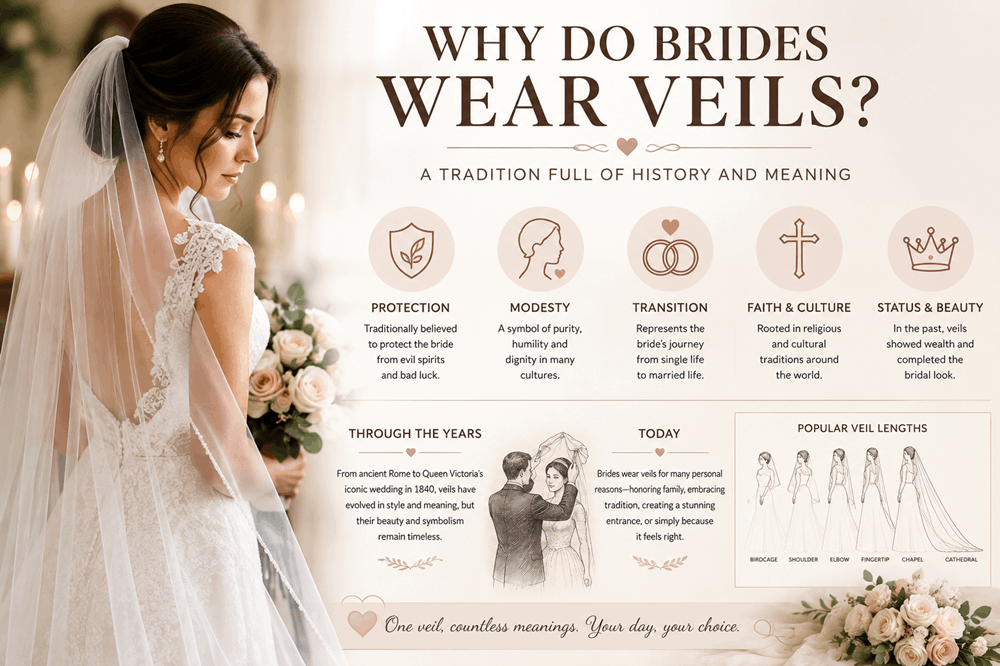
Historically, bridal veils have been associated with protection, modesty, status, religious observance, and the transition into married life. However, there is no single origin story or universal meaning that applies to every bride.
For many modern brides, the decision is much simpler: wearing a veil makes the wedding outfit feel complete. Others choose one to honor a family tradition, create a dramatic entrance, or wear an heirloom passed down through generations.
A bride does not have to wear a veil, and choosing one does not automatically communicate purity, obedience, or any other traditional idea. Its meaning depends on the bride, her culture, and the ceremony she is planning.
Why Do Brides Traditionally Wear Veils?
The most common historical explanations are that bridal veils were worn to:
- Protect the bride from harmful spirits or bad luck
- Represent modesty or dignity
- Mark the transition from unmarried to married life
- Follow a religious or cultural custom
- Display family wealth or social status
- Conceal the bride’s face during arranged marriages
- Complete a fashionable bridal ensemble
Some of these explanations are better documented than others. Wedding traditions often develop across several cultures and centuries, making it difficult to identify one moment when the modern veil began.
It is therefore more accurate to say that the bridal veil has accumulated different meanings over time rather than beginning with one fixed purpose.
Did Wedding Veils Begin in Ancient Rome?
Ancient Roman brides wore a distinctive veil called the flammeum. It was not the white or ivory tulle veil commonly associated with weddings today. Historical descriptions identify it as a bright yellow or yellow-orange covering worn over the bride’s face and hair.
The flammeum was one part of a larger Roman bridal outfit that could also include a woven tunic, a belt, flowers, and a carefully arranged hairstyle. Marriage was treated as a major transition in a Roman girl’s social and family position, and her clothing helped mark that change.
Modern articles frequently claim that Roman brides wore veils specifically to frighten away evil spirits. That explanation is widely repeated, but the surviving history is more complicated than a single superstition. The veil was also connected to ceremonial dress, respectable womanhood, marriage, and the bride’s passage into a new household.
The Roman flammeum helps show that bridal veiling is ancient, but it was not identical in appearance or meaning to the modern white wedding veil.
Were Veils Meant to Hide the Bride’s Face?
In some times and places, a veil did conceal the bride’s face. This has encouraged the popular story that veils existed mainly because a groom in an arranged marriage was not supposed to see the bride until the ceremony was complete.
That may reflect certain marriage practices, but it is too narrow to explain the entire tradition.
Veils have also been worn when the couple already knew one another well, and many historical veils covered the head or hair without fully hiding the face. Others were sheer enough for the bride to see and be seen.
Concealment was therefore one possible function, not the universal purpose of every bridal veil.
Did the Veil Represent Purity?
The veil has sometimes been interpreted as a sign of purity, chastity, or modesty, particularly in later European and Christian wedding traditions.
However, it is important not to assume that every bride who wears a veil is making a statement about sexual purity. That interpretation is only one layer of the garment’s long history.
Religious head coverings have often represented reverence, dignity, modesty, or respect during sacred occasions. As bridal fashion and religious ceremony became closely connected in parts of Europe, the veil could take on similar associations.
Today, some brides appreciate that spiritual meaning. Others wear a veil purely because they like its shape, movement, or connection to bridal fashion.
How Queen Victoria Influenced the Modern Bridal Veil
Queen Victoria’s 1840 wedding to Prince Albert had an enormous influence on Western bridal fashion.
Rather than wearing her crimson royal robes, Victoria chose a white satin gown with orange blossoms and lace. The outfit presented her as a bride rather than primarily as a monarch and attracted widespread public attention.
Victoria also wore a white lace veil. Her highly publicized wedding helped make the combination of a white dress and white veil fashionable among brides who could afford to imitate the royal style.
She did not invent either the white wedding dress or the bridal veil. Brides had worn both before 1840. Her influence came from turning that particular combination into an admired and widely copied ideal.
During the Victorian era, elaborate lace veils could also demonstrate wealth. Fine handmade lace required considerable time and skill, making it an expensive and noticeable part of the wedding ensemble.
Why Does Someone Lift the Bride’s Veil?
A veil that covers the face is sometimes called a blusher. It may be lifted before the ceremony begins, when the bride reaches the altar, before the vows, or before the couple’s first kiss.
Traditionally, the person escorting the bride or the bride’s partner may lift it. Some brides prefer to lift it themselves.
Several meanings have been attached to this moment:
- The bride is being presented to her partner.
- The couple is beginning married life openly.
- A barrier between them is being removed.
- The bride is completing her entrance into the ceremony.
Some older interpretations connect the gesture to the transfer of a bride from her father’s authority to her husband’s authority. Many modern couples understandably do not identify with that meaning.
A bride can decide who lifts the veil—or skip the face covering entirely. Most modern veils are worn behind the head and never cover the face.
What Does a Veil Mean in a Jewish Wedding?
In many Ashkenazi Jewish weddings, the couple may participate in a veiling ceremony called the bedeken before standing beneath the chuppah.
During the traditional ceremony, the groom places a veil over the bride’s face. Interpretations of the custom include modesty, dignity, recognition of inner character, and a connection to biblical matriarchs.
One commonly cited connection is the biblical account of Rebecca covering herself with a veil when she saw Isaac. Another refers to the story of Jacob, who was deceived into marrying Leah instead of Rachel, although Jewish sources recognize that the custom has accumulated several explanations rather than one definitive meaning.
Contemporary couples may adapt the bedeken to reflect their own values. Some couples cover or present garments to one another, making the moment reciprocal rather than something performed only for the bride.
Jewish wedding customs vary by community, family, and level of observance, so couples should discuss the ceremony with their rabbi or officiant.
Why Do Modern Brides Still Wear Veils?
Most modern brides who wear veils do so because the accessory feels meaningful, beautiful, or unmistakably bridal.
It completes the wedding look
A veil can change the appearance of a dress without requiring a different gown. Its softness can balance structured fabric, while lace or embroidery can repeat details from the dress.
Many brides say they liked their gown during a fitting but felt like a bride only after adding the veil.
It creates a memorable entrance
A long veil moves as the bride walks and can add visual drama to the processional. Cathedral-length styles are especially effective in large churches, ballrooms, gardens, and outdoor ceremony spaces.
It honors tradition
A bride may wear a veil because her mother, grandmother, or other relatives did. Even when the style is new, the gesture can create a connection between generations.
It can be an heirloom
Some families preserve wedding veils and pass them from one person to another. An heirloom veil may be repaired, shortened, restyled, or attached to a modern comb.
A bride may also use lace from an older veil to decorate a new one.
It adds meaning to the ceremony
Putting on the veil can mark the emotional transition from preparing for the wedding to entering the ceremony.
The accessory may become part of a quiet moment with a parent, sibling, friend, or member of the wedding party.
It improves the photographs
Veils create movement and texture in photographs. A photographer may use the fabric in portraits, wide ceremony images, or outdoor photographs when the wind is gentle.
Photography should not be the only consideration, but it is one reason some brides choose a veil even when they do not wear it for the entire celebration.
Does Wearing a Veil Mean the Bride Is a Virgin?
No.
Although veils have historically been linked with modesty or purity in some communities, wearing one does not reveal anything about a bride’s personal history.
Modern brides may wear veils whether they are marrying for the first time, remarrying, already have children, or have been living with their partners for years.
A veil is an article of clothing, not evidence of someone’s private life. Its significance should be determined by the person wearing it rather than by assumptions made by guests.
Do Second-Time Brides Wear Veils?
Yes. A bride can wear a veil for any wedding, regardless of whether it is her first marriage.
Older etiquette rules sometimes suggested that second-time brides should avoid elaborate white dresses and veils. Those restrictions no longer reflect how most couples approach modern weddings.
A bride remarrying might choose:
- A short birdcage veil
- A shoulder-length veil
- A simple fingertip veil
- A lace mantilla
- A dramatic cathedral veil
- A floral headpiece instead of a veil
- No head covering at all
The best choice is the one that suits the ceremony and makes the bride feel comfortable.
Do Brides Have to Cover Their Faces?
No. Many bridal veils attach to the back or top of the hair and fall entirely behind the bride.
A bride who wants the traditional face-covering effect can choose a veil with a blusher. A bride who dislikes fabric near her face can select a single-tier style that remains behind her.
The Church of England, for example, notes that brides have flexibility in how they enter a church wedding and are not legally required to follow one prescribed processional tradition.
Religious venues or individual communities may have their own expectations for clothing and head coverings, so couples should ask the officiant when planning the ceremony.
Common Types of Wedding Veils
The meaning of a veil may be personal, but its length and construction affect how it looks and feels.
Birdcage veil
A short net veil that covers part of the face. It suits vintage, civil, and less formal wedding styles.
Shoulder-length veil
A light, manageable style that ends near the shoulders. It adds softness without covering much of the dress.
Elbow-length veil
This style ends near the elbows or waist and works well when the bride wants a traditional shape without a floor-length train.
Fingertip veil
A popular and versatile length that generally falls near the bride’s fingertips.
Waltz or ballet-length veil
This veil falls between the knees and ankles. It creates movement while allowing the bride to walk and dance more easily than she might with a longer style.
Chapel veil
A floor-length veil that extends slightly beyond the gown.
Cathedral veil
A formal veil that trails behind the bride and creates a dramatic entrance. It requires more room and may need help from an attendant.
Mantilla veil
A circular or oval veil, often with a lace border, traditionally placed over the head and shoulders.
How to Decide Whether to Wear a Veil
Ask yourself what you want the accessory to contribute.
Consider:
- Does the veil make the outfit feel more complete?
- Does it hold cultural, religious, or family meaning?
- Will it work comfortably in the venue?
- Does it complement rather than hide the dress?
- Can it be secured to your hairstyle?
- Will wind, heat, stairs, or narrow aisles create problems?
- Do you want to wear it during the reception?
- Who will help remove or adjust it?
Try the veil with the actual dress whenever possible. A style that looks delicate by itself may compete with heavily embellished fabric, while a simple dress may work beautifully with embroidered lace.
Bring the veil to a hair trial so the stylist can determine where to attach it and how easily it can be removed.
When Should the Bride Remove Her Veil?
There is no required time.
A bride may remove the veil:
- After the ceremony
- After formal portraits
- Before entering the reception
- Before dinner
- Before dancing
- At the end of the evening
- Not at all
Long veils can be difficult to manage in a crowded reception. Some brides replace them with a bow, comb, headband, flower, or shorter second veil.
If the veil is attached beneath an updo, make sure it can be removed without disturbing the hairstyle.
Alternatives to a Wedding Veil
A bride who does not want a veil can wear:
- A floral crown
- Fresh flowers
- A jeweled comb
- A headband
- A tiara
- A hair bow
- A cape
- A detachable train
- A hat
- A scarf
- Nothing at all
Skipping a veil does not make an outfit less bridal. A well-chosen dress, suit, jumpsuit, or other ensemble can feel complete without a head covering.
Frequently Asked Questions
What is the original purpose of a wedding veil?
There is no single confirmed original purpose. Historical veils have been connected with ceremonial dress, protection, modesty, marriage, status, and the bride’s transition into a new household.
Why did Roman brides wear veils?
Roman brides wore a yellow-orange veil known as the flammeum as part of their ceremonial wedding attire. It covered the face and hair and was associated with the bride’s new marital status.
Why are most wedding veils white?
White veils became strongly associated with Western bridal fashion after Queen Victoria wore a white gown and lace veil at her 1840 wedding. The royal wedding helped popularize the coordinated white bridal ensemble.
Who is supposed to lift the veil?
The bride, her escort, or her partner may lift it. Couples can choose whichever approach feels most comfortable and meaningful.
Can an older bride wear a veil?
Yes. There is no age limit for wearing a veil.
Can a bride wear a veil at a courthouse wedding?
Yes. Short veils, birdcage styles, and simple fingertip veils can work especially well for civil ceremonies, but longer styles are also an option.
A Wedding Veil Can Mean Whatever the Bride Chooses
Brides have worn veils for centuries, but not always for the same reason.
The garment has represented ceremonial protection, modesty, status, religious tradition, family continuity, and the transition into marriage. Queen Victoria helped transform the white lace veil into an enduring feature of Western bridal fashion, while different religious and cultural communities developed meanings of their own.
For a modern bride, a veil may carry all of that history—or none of it. She may wear one because it honors her faith, belonged to her grandmother, creates a beautiful entrance, or simply makes her happy when she looks in the mirror.
The most meaningful explanation is not what a veil once meant to every bride. It is what the chosen veil means to the person wearing it now.