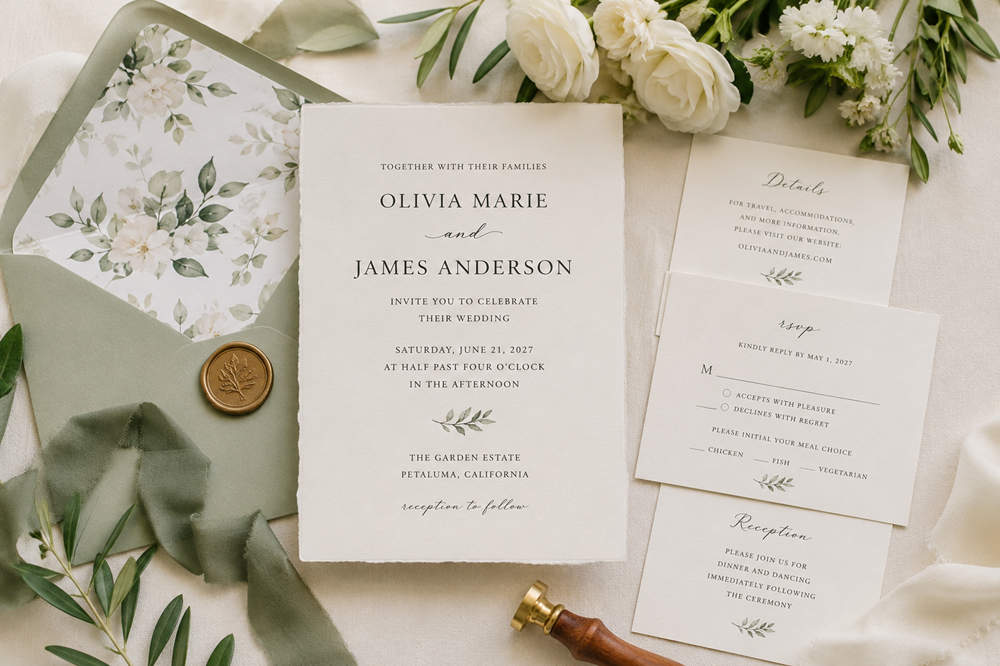
What Should Be Included in a Wedding Invitation? A Complete Checklist
A wedding invitation should include the hosts, the couple’s names, an invitation line, the wedding date and time, the ceremony venue, and a brief note about the reception. These details give guests the essential information they need to attend.
RSVP instructions, travel arrangements, accommodation details, and weekend schedules can be placed on enclosure cards or the wedding website. Keeping those elements separate makes the main invitation easier to read and gives each piece of the suite a clear purpose.
What Should Be Included on the Main Wedding Invitation?
Regardless of whether the wording is formal, modern, or casual, the main invitation should answer six basic questions: who is hosting, who is getting married, what guests are being invited to, when the ceremony begins, where it will take place, and what follows.
The Host Line
The host line appears near the top of the invitation and identifies the person or people inviting guests to the wedding. Depending on the hosting arrangement, it may name one set of parents, both families, the couple, or several family members together.
For example:
Mr. and Mrs. Daniel Williams
request the pleasure of your company
When the couple and their families are sharing the celebration, a simple alternative is:
Together with their families
A couple hosting the wedding themselves may begin directly with their names. The wording does not need to describe who paid for each part of the event. It only needs to reflect who is formally welcoming the guests.
The Couple’s Names
The couple’s names should be one of the most prominent elements on the card. Full names are common on traditional invitations, while first and last names often suit modern designs. First names alone may work for a small or informal celebration.
Choose the version of each name that guests will recognize, and keep the presentation consistent. The order of the names is a personal choice unless the couple is following a particular family, cultural, or religious tradition.
The Invitation or Request Line
The request line tells guests what they are being invited to attend. Its wording also helps establish the tone of the wedding.
Traditional options include:
- Request the honour of your presence
- Request the pleasure of your company
In traditional etiquette, “the honour of your presence” is associated with a ceremony in a house of worship, while “the pleasure of your company” is used for other venues. Formal wording may also change according to the hosting arrangement, as shown in these wedding invitation wording examples.
A modern or casual invitation can use warmer language, such as:
- Invite you to celebrate their marriage
- Invite you to join them as they get married
- Would love for you to celebrate with them
The request line should feel natural beside the design and setting. A formal church ceremony may call for traditional language, while a garden, beach, or backyard wedding can use simpler wording.
The Wedding Date
Include the day of the week, calendar date, month, and year. Writing out the month reduces the chance of confusion, especially when guests may be accustomed to different numerical date formats.
A formal date might appear as:
Saturday, the eighteenth of September
two thousand twenty-seven
A modern version could be:
Saturday, September 18, 2027
Use one style throughout the invitation. If the date is fully written out, the time and year should generally follow the same formal approach. A contemporary design can use standard numerals instead.
The Ceremony Time
Print the actual ceremony start time rather than an earlier time intended to encourage punctuality. Guests generally understand that they should arrive before the listed time to park, enter the venue, and find their seats.
The time can be written formally:
at half after four o’clock
Or presented more simply:
4:30 p.m.
Make sure the time on the invitation agrees with the venue contract, wedding website, transportation schedule, and any reminder sent to guests.
The Ceremony Venue and Location
Include the official venue name followed by the city and state, province, region, or country.
For example:
Willow Creek Estate
Napa, California
A full street address is useful when the venue is difficult to find, has a name shared by several properties, or is unfamiliar to most guests. Directions, parking instructions, gate codes, and shuttle information should usually appear on a details card or the wedding website rather than on the main invitation.
The Reception Line
When the ceremony and reception take place at the same venue, a short line near the bottom of the invitation can explain what follows.
Common options include:
- Reception to follow
- Dinner and dancing to follow
- Cocktails, dinner, and dancing to follow
- Celebration immediately following the ceremony
If the reception will be held at another location, place its venue, address, and start time on a separate reception card.
What Should Be Included in the Invitation Suite?
Beyond the main invitation and an RSVP method, the pieces in an invitation suite are optional. Select them according to the wedding’s location, schedule, and guest needs rather than adding cards simply because they are traditional.
RSVP Instructions: Essential
Every guest needs a clear way to accept or decline the invitation. Responses may be collected through a paper card, a wedding website, or a combination of both.
RSVP instructions should include:
- The response deadline
- A space for the guest’s name
- Acceptance and decline options
- The number attending, when appropriate
- Meal choices or dietary needs, when required
- A return or online response method
Common formal wording includes:
Accepts with pleasure
Declines with regret
For online responses, include a small card with the wedding website address and the RSVP deadline. A QR code can be added for convenience, but the written web address should remain visible in case the code cannot be scanned.
When using paper replies, provide a pre-addressed envelope and the correct return postage. Couples using digital responses can omit the paper reply envelope as long as the online instructions are easy to find and follow.
Reception Card: When the Venues Differ
A separate reception card is most useful when the ceremony and reception are held at different venues. It gives the second location enough space without crowding the main invitation.
The card should include:
- The reception venue
- The street address, when helpful
- The start time
- A short description of the event
For example:
Reception
Cocktails, dinner, and dancing
beginning at six o’clock
The Grandview Ballroom
118 Crescent Avenue
Charleston, South Carolina
Each household should receive details only for the wedding events to which its members are invited.
Details Card: When Guests Need Extra Guidance
A details card holds practical information that guests may need before arriving. It is particularly valuable for venues with limited parking, arranged transportation, unusual entrances, or outdoor conditions.
It may include:
- Parking locations
- Shuttle times and pickup points
- Directions between venues
- Entrance or security instructions
- Accessibility information
- Outdoor surface or weather notes
- Important venue restrictions
Keep the printed card concise. Longer explanations can appear on the wedding website, with the card directing guests to the appropriate page. A wedding details card is most effective when it contains only information guests genuinely need.
Accommodation Card: For Traveling Guests
An accommodation card can help out-of-town guests make arrangements, particularly when rooms are reserved in a hotel block or nearby lodging is limited.
Include confirmed information such as:
- Hotel names
- Booking codes
- Reservation deadlines
- Group rates
- Airport or station details
- Transportation between hotels and venues
If rates, links, or shuttle schedules may change, place the most current information on the wedding website and use the printed card to guide guests there.
Weekend Schedule: For Multi-Event Celebrations
A schedule card is helpful when invited guests will attend several events during the wedding weekend.
Depending on the celebration, it might include:
- A welcome party
- A rehearsal dinner
- The ceremony and reception
- A farewell brunch
- A planned group activity
List the date, time, location, and attire for each relevant event. When the guest lists differ, prepare separate schedule cards so recipients do not receive information about private events they are not attending.
The Wedding Website
The wedding website can hold information that is too detailed or likely to change after the invitations are printed.
Useful website content includes:
- Online RSVP forms
- Maps and directions
- Hotel and travel information
- Transportation schedules
- Dress-code guidance
- Accessibility details
- Weekend updates
- Answers to practical guest questions
Place the website address on an enclosure card rather than expecting guests to search for it. Keep the address short and proofread it carefully before printing.
Should the Dress Code Be Included?
Dress-code information can prevent uncertainty, especially when the wedding’s level of formality is not obvious from the venue, time, or invitation design.
Modern invitation suites often place a short dress code at the bottom of the invitation, on a details card, or on the wedding website. Couples following strict traditional etiquette may prefer to leave attire off the ceremony invitation; formal guidance from Emily Post says that “Black tie,” when necessary, may appear on a separate reception invitation.
Common dress codes include:
- Black tie
- Black-tie optional
- Formal attire
- Cocktail attire
- Semi-formal attire
- Garden party attire
- Dressy casual
- Casual attire
Keep the printed wording brief. Use the wedding website to explain details such as footwear for a lawn, warm layers for an evening ceremony, or clothing suited to a religious venue.
Wedding Invitation Wording Examples
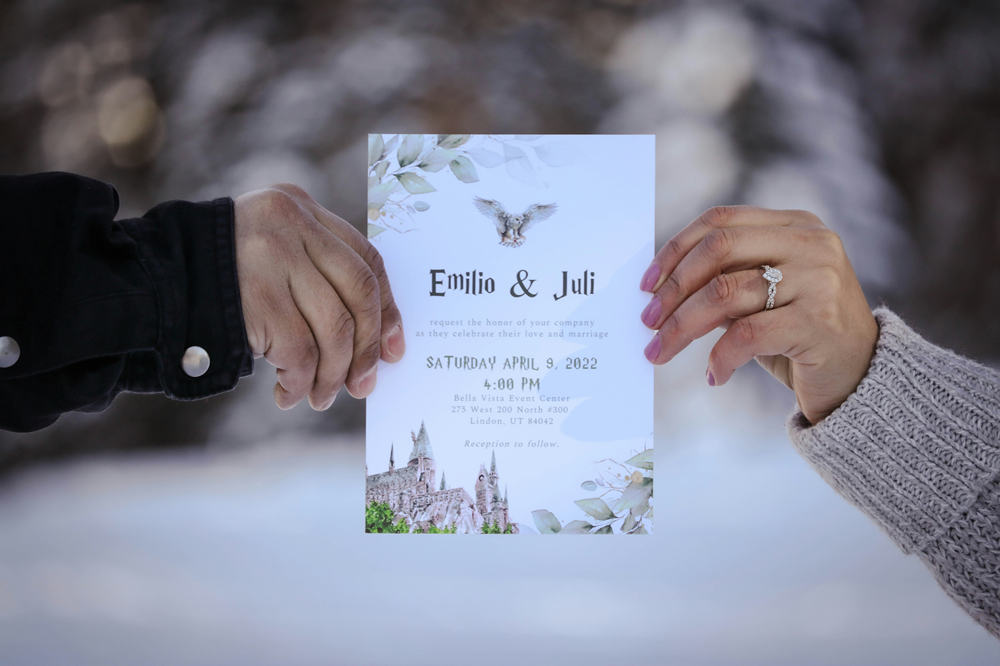
These complete examples show how the essential information can be arranged without overloading the invitation. All names and locations are fictional.
Traditional Formal Invitation
Mr. and Mrs. Jonathan William Bennett
request the honour of your presence
at the marriage of their daughter
Charlotte Elizabeth
to
Mr. Alexander James Morgan
Saturday, the eighteenth of September
two thousand twenty-seven
at half after four o’clock
Saint Andrew’s Church
Savannah, Georgia
Reception to follow
Modern Invitation
Together with their families
Maya Thompson
and
Lucas Reed
invite you to celebrate their wedding
Saturday, June 19, 2027
at five o’clock in the afternoon
The Glasshouse Garden
Portland, Oregon
Dinner and dancing to follow
Casual Invitation
We’re getting married!
Join Emma & Noah
for an afternoon of love, food, and dancing
Sunday, August 8, 2027
at 3:30 p.m.
Cedar Hill Farm
Asheville, North Carolina
Celebration to follow
Ceremony and Reception at Different Venues
Main invitation:
Together with their families
Sofia Martinez
and
Henry Walker
invite you to celebrate their marriage
Saturday, November 6, 2027
at two o’clock in the afternoon
Grace Chapel
Austin, Texas
Reception card:
Reception
Cocktails, dinner, and dancing
beginning at five o’clock
The Magnolia Room
450 Westlake Drive
Austin, Texas
Final Wedding Invitation Checklist
Before approving the final proof, ask at least one other person to review the entire suite. A fresh reader may notice a misspelled name, inconsistent time, or incorrect address that has become easy to overlook.
- Confirm the hosts’ names and titles.
- Check the couple’s names and spelling.
- Review the request line.
- Match the day of the week to the calendar date.
- Confirm the year and ceremony time.
- Verify the official venue name and address.
- Check the reception location and start time.
- Review the RSVP deadline and response method.
- Test the wedding website and QR code.
- Confirm accommodation and transportation details.
- Check the dress code across every card and web page.
- Add the correct return address to the envelope.
- Review capitalization, punctuation, and formatting.
After proofreading, assemble one complete invitation exactly as it will be mailed, including every card, envelope liner, ribbon, wax seal, or decorative element. Take it to a Post Office counter to confirm its weight, thickness, machinability, and required postage.
USPS notes that square, vertical, rigid, lumpy, or unusually embellished envelopes may be treated as nonmachinable and require additional postage or hand processing. Its guidance for mailing decorated invitations recommends checking the finished envelope at a retail counter when special handling may be needed.
Keep the main invitation focused on the ceremony, place logistical details on supporting cards or the wedding website, and test the assembled suite before mailing. Guests should be able to understand where to go, when to arrive, and how to respond without searching for missing information.