Do You Wear Your Engagement Ring on Your Wedding Day Ceremony?
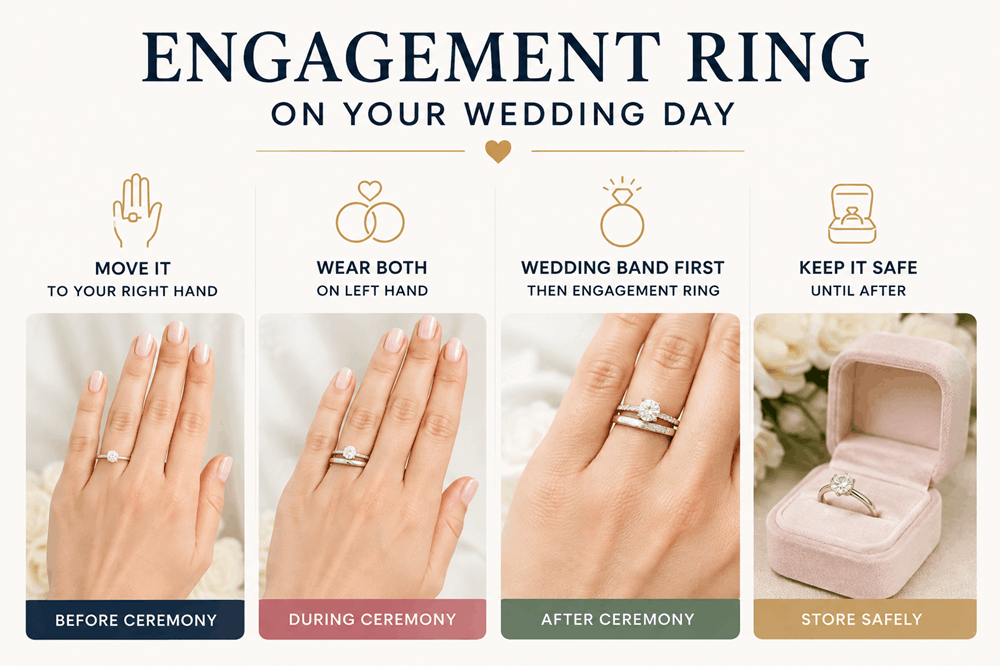
Yes, you can wear your engagement ring on your wedding day. The most traditional approach is to move it temporarily to your right hand before the ceremony, leaving your left ring finger open for the wedding band. After the ceremony, you can move the engagement ring back and place it above the wedding band.
You can also leave the engagement ring on your left hand, ask someone trusted to hold it, or keep it in a secure jewelry box until after the vows. There is no mandatory rule. The best choice depends on comfort, ring fit, family tradition, and how you want the exchange to look during the ceremony.
What Happens to Your Engagement Ring During the Wedding Ceremony?
The wedding band is traditionally placed directly on the ring finger during the ceremony. For many couples in the United States, Canada, the United Kingdom, and similar Western traditions, that means the fourth finger of the left hand.
If your engagement ring is already on that finger, you have several options:
- Move the engagement ring to your right hand before the ceremony.
- Leave it on your left hand and place the wedding band above it.
- Ask an attendant or family member to hold it.
- Keep it in a secure ring box until after the ceremony.
- Wear it on another finger temporarily.
- Wear only the engagement ring and add the wedding band later.
Each option is acceptable. The choice should make the ring exchange easier rather than adding another detail to worry about.
The Traditional Way to Wear Your Engagement Ring
The traditional wedding-day arrangement is to place the wedding band on the finger first and the engagement ring above it.
The final order usually looks like this:
- Wedding band closest to the base of the finger
- Engagement ring directly above the wedding band
- Optional anniversary or stacking band above both rings
The wedding band is sometimes described as sitting closer to the heart, although this is symbolic rather than anatomical. The tradition gives the wedding ring the first position because it represents the marriage vows exchanged during the ceremony.
To achieve that order without rearranging the rings in front of everyone, many people move the engagement ring to their right hand before walking down the aisle. Once the ceremony ends, they return it to the left hand and place it above the newly received wedding band.
Can You Leave the Engagement Ring on Your Left Hand?
Yes. You can leave your engagement ring exactly where it normally sits.
During the ring exchange, your partner can place the wedding band above the engagement ring. You can switch their positions after the ceremony, or you can keep them in that order if it looks and feels better.
This option may be especially convenient when:
- The engagement ring does not fit on your right hand.
- You are worried about misplacing it.
- You want it visible in ceremony photographs.
- Your wedding band can slide over the engagement ring easily.
- You do not care about the traditional stacking order.
One possible difficulty is that a raised engagement-ring setting may make it awkward to slide the wedding band over it. Test the movement before the wedding day. If the wedding band catches on the center stone or prongs, another arrangement may be easier.
Should You Move the Engagement Ring to Your Right Hand?
Moving the engagement ring to your right hand is one of the simplest and most popular choices.
Before relying on this method, try the ring on your right ring finger. Fingers on opposite hands are not always the same size. Your dominant hand may have slightly larger fingers, which could make the engagement ring feel tight.
Do not force the ring onto your right hand. A ring that feels comfortable in the morning may become difficult to remove after heat, stress, travel, or temporary swelling.
If it fits safely, move the ring before getting dressed or shortly before leaving for the ceremony. After the vows, transfer it back to your left hand when you have a private, calm moment.
Can Someone Hold Your Engagement Ring?
You can ask your maid of honor, best person, parent, sibling, or another trusted individual to hold the engagement ring during the ceremony.
This keeps the left ring finger completely clear and avoids possible problems with fit on the right hand.
However, the ring should never be carried loosely in a pocket, handbag, tissue, or hand. Give the person a secure ring box, zippered pouch, or small jewelry case.
Make the responsibility clear before the wedding day. Tell the person:
- When you will give them the ring
- Where they should keep it
- When you want it returned
- Whether it should appear in photographs
Choose someone organized who will not be managing too many other wedding-day items.
Can You Keep the Engagement Ring in Its Box?
Yes. Keeping the engagement ring in a secure box may be the safest choice if you do not want to wear it during the ceremony.
The box can remain:
- In a locked hotel-room safe
- With a trusted family member
- Inside a secured bridal suite
- With the wedding planner
- In another agreed and supervised location
Avoid leaving valuable jewelry unattended in an unlocked dressing room, vehicle, open handbag, or busy preparation area.
You can put the ring on again immediately after the ceremony or before formal portraits begin.
Should You Wear the Engagement Ring While Getting Ready?
You may want to remove your engagement ring while applying makeup, styling your hair, using hairspray, or getting dressed.
Beauty products can leave residue on the stone and setting. Clothing, lace, beading, and delicate fabric can also catch on raised prongs.
A practical approach is to keep the ring in a designated jewelry box while you get ready, then put it on after your outfit, makeup, and hair are complete.
Some photographers may want to take detail photographs of the engagement ring with:
- The wedding bands
- The invitation suite
- Flowers
- Perfume
- Shoes
- Vows
- Other meaningful accessories
Ask the photographer to return every ring directly to you or a named attendant after the photographs.
What If Your Right Ring Finger Is a Different Size?
It is common for the fingers on one hand to be slightly larger than those on the other. Your dominant hand may be broader because you use it more often.
If the engagement ring is too tight on the right ring finger, you could:
- Wear it on your right middle finger.
- Place it on another comfortable finger.
- Ask someone to hold it securely.
- Leave it in a jewelry box.
- Keep it on your left hand.
Do not resize your engagement ring solely for a few hours of wedding-day wear unless it already needs adjustment.
What If Your Engagement Ring and Wedding Band Do Not Fit Together?
Some engagement rings have low baskets, large center stones, wide bands, or unusual settings that prevent a straight wedding band from sitting flush beside them.
Your rings do not need to touch perfectly. A small gap can be part of the design. However, the rings should not press against each other in a way that damages the metal or stones.
Possible solutions include:
- A curved wedding band
- A contoured band
- An open wedding band
- A custom-fitted band
- Wearing the rings on separate hands
- Wearing one ring at a time
Try the complete set well before the wedding. A jeweler can check whether the bands rub against prongs, galleries, or accent stones.
Can the Wedding Band Go Above the Engagement Ring?
Yes. You can wear the wedding band above the engagement ring if that order feels more comfortable or looks better.
Although the traditional order places the wedding band first, ring stacking is a personal choice. Certain designs are intentionally created to fit better in the opposite arrangement.
You might place the wedding band above the engagement ring because:
- It helps hold a loose engagement ring in place.
- The band’s curve fits better above the center setting.
- You prefer the visual balance.
- You do not want to rearrange the rings after the ceremony.
- Your family or culture follows a different custom.
The meaning of the rings does not change because of their order.
Do You Have to Wear Both Rings After the Wedding?
No. You can wear both rings, only the wedding band, only the engagement ring, or alternate between them.
Some people wear only the wedding band every day because it is simpler and more practical. The engagement ring may be reserved for weekends, dinners, celebrations, and special occasions.
You may choose not to wear the engagement ring daily because of:
- Your occupation
- Exercise or sports
- Frequent hand washing
- A high or delicate setting
- Comfort concerns
- Travel
- Safety around machinery
Your marriage is not measured by how many rings you wear at once.
Should You Solder the Engagement Ring and Wedding Band Together?
Soldering connects the two rings so they remain aligned and move as one piece.
Possible benefits include:
- Less spinning
- Reduced rubbing between the rings
- A consistent stacked appearance
- Less need to adjust the bands throughout the day
Possible disadvantages include:
- You cannot easily wear the rings separately.
- Resizing may become more complicated.
- Repairs can require work on the full set.
- Your style preferences may change later.
There is no need to make this decision before the wedding. Wear the rings together for a while and see how they feel before permanently joining them.
What About Cultural and Religious Ring Traditions?
Wedding-ring customs vary between cultures, countries, families, and faiths.
Some people wear engagement and wedding rings on the right hand. Others move a ring from one hand to the other during the wedding ceremony. Certain ceremonies use a plain wedding band for religious reasons, while decorative rings are added afterward.
Family members may have strong opinions, but you and your partner can decide which traditions matter to you.
When the ceremony has specific religious requirements, ask your officiant whether:
- The wedding band must be plain
- The ring must be placed on a particular hand
- Only one ring is used during the ceremony
- The engagement ring should be removed
- The ring exchange occurs at a particular point
Knowing the expectations early prevents confusion during the rehearsal.
What Do Same-Sex Couples Do With Engagement Rings?
Same-sex couples can arrange engagement and wedding rings in any way that reflects their relationship.
Both partners may:
- Wear engagement rings before the ceremony.
- Move the engagement rings to the opposite hand.
- Exchange separate wedding bands.
- Use their engagement rings as wedding rings.
- Wear matching stacks.
- Choose completely different arrangements.
There is no need to assign traditional gender roles to the rings. Each partner can decide what feels comfortable and meaningful.
Can Your Engagement Ring Become Your Wedding Ring?
Yes. You do not have to purchase a separate wedding band.
You can use the engagement ring during the ceremony as the wedding ring, especially when:
- You prefer wearing one ring.
- The engagement ring already has a band-like design.
- You want to reduce wedding expenses.
- A second ring would feel uncomfortable.
- The ring has special family significance.
During the ceremony, your partner may remove the ring briefly and place it back on your finger while saying the vows. Alternatively, the ring may remain in place while the exchange is acknowledged symbolically.
Discuss the plan with your officiant during the rehearsal.
Should You Clean the Engagement Ring Before the Wedding?
Cleaning the ring before the wedding can help it look bright in photographs and beside the new wedding band.
Arrange professional cleaning and inspection one or two weeks before the event. This gives the jeweler time to address loose prongs or minor problems without creating last-minute stress.
Ask the jeweler to examine:
- Center-stone security
- Accent stones
- Prongs
- The setting
- The band
- Any engravings
Avoid experimenting with unfamiliar cleaning chemicals immediately before the wedding. Certain gemstones and treated stones require special care.
Wedding-Day Ring Safety Tips
Engagement rings and wedding bands are small, valuable, and easy to misplace in a busy preparation space.
Protect them by following a simple plan:
- Choose one secure ring box.
- Name one person responsible for the rings.
- Do not leave rings near sinks or open drains.
- Keep them away from tissues, towels, and makeup bags.
- Do not place them loosely in dress pockets.
- Confirm who has the rings before leaving for the ceremony.
- Return them immediately after detail photographs.
Too many people handling the rings can create confusion. A clear chain of responsibility is safer.
Frequently Asked Questions
Do brides normally wear their engagement rings during the wedding?
Many do. Some move the engagement ring to the right hand temporarily, while others leave it on the left hand or keep it safely stored until after the ceremony.
Which ring goes on first during the wedding?
The wedding band is traditionally placed on the finger first, followed by the engagement ring.
Can the wedding ring be placed over the engagement ring?
Yes. You can rearrange the rings after the ceremony or leave them in that order.
What if the engagement ring does not fit on the right hand?
Keep it on the left hand, wear it on another comfortable finger, or ask a trusted person to hold it securely.
Can you wear only your wedding band on the wedding day?
Yes. You can keep the engagement ring in a secure location and put it on after the ceremony or at another time.
Do you need a separate wedding band?
No. Your engagement ring can also serve as your wedding ring if you prefer one ring.
When should you move the engagement ring back?
You can move it immediately after the ceremony, before formal portraits, during a private moment, or whenever it feels convenient.
Wear Your Engagement Ring in the Way That Feels Easiest
You can wear your engagement ring on your wedding day, but you do not have to follow one strict arrangement.
The traditional method is to move the engagement ring to your right hand before the ceremony, receive the wedding band on your left ring finger, and return the engagement ring above it afterward. You may instead leave the engagement ring in place, ask someone to hold it, or store it securely until the vows are complete.
Test the fit of both rings before the wedding and create a simple plan for who will handle them. The arrangement should protect your jewelry, support the ceremony, and help you feel comfortable—not create another source of stress.