
Major Activities of the Planning Section Include What? A Clear ICS Guide
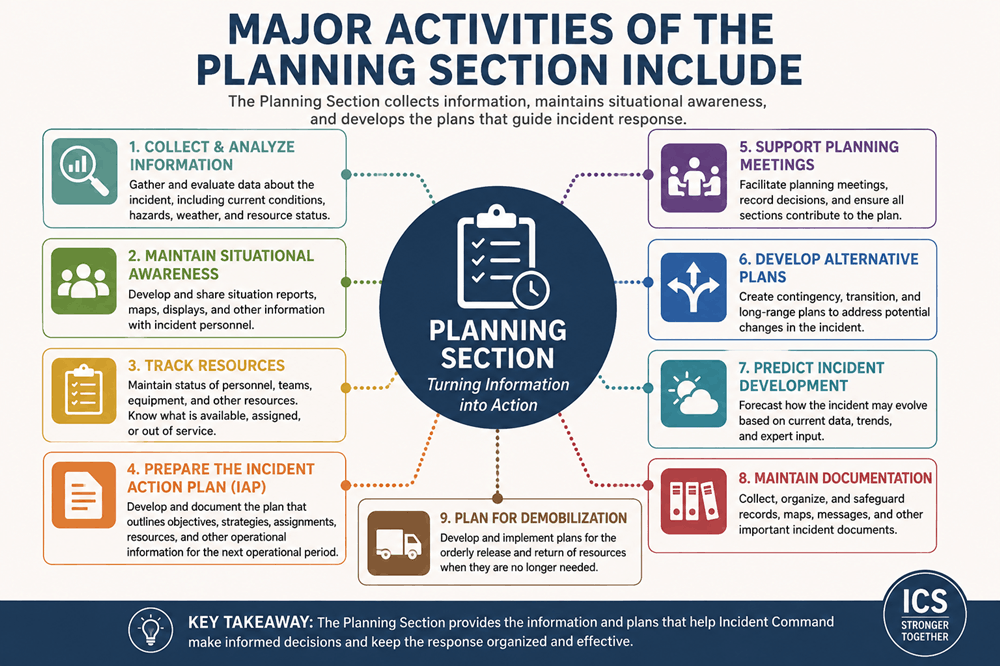
The major activities of the Planning Section include collecting and evaluating incident information, tracking resources, preparing status reports, developing the Incident Action Plan, supporting planning meetings, maintaining incident documentation, forecasting future needs, and preparing for demobilization.
Within the Incident Command System, or ICS, the Planning Section turns changing incident information into an organized plan. It does not normally direct firefighters, police officers, medical teams, or other tactical resources in the field. Instead, it helps Incident Command understand what is happening now, what resources are available, what may happen next, and what actions should be planned for the next operational period.
FEMA describes the Planning Section as responsible for collecting, evaluating, and distributing incident information, maintaining resource status, displaying situation information, and preparing and documenting the Incident Action Plan.
Quick Answer
The major activities of the Planning Section include:
- Collecting and analyzing incident information
- Maintaining situational awareness
- Tracking personnel, teams, equipment, and other resources
- Preparing and updating status reports, maps, and displays
- Developing and documenting the Incident Action Plan
- Facilitating planning meetings
- Preparing contingency, transition, and long-range plans
- Forecasting how the incident may develop
- Maintaining official incident records
- Planning the orderly release of resources
- Coordinating technical specialists when needed
These activities help Incident Command make decisions using organized, current, and verified information.
What Is the Planning Section?
The Planning Section is one of the main functional sections within the Incident Command System.
The four commonly recognized General Staff sections are:
| ICS section | Primary responsibility |
|---|---|
| Operations | Carries out tactical activities |
| Planning | Collects information and prepares plans |
| Logistics | Provides personnel, supplies, facilities, and support |
| Finance/Administration | Tracks costs, claims, time, and financial matters |
The Planning Section is led by the Planning Section Chief, who reports to the Incident Commander or Unified Command.
The section becomes especially important when an incident grows more complex. During a small, short event, the Incident Commander may handle planning personally. During a prolonged emergency involving multiple agencies and operational periods, a dedicated Planning Section may be needed to organize information and support continuing decisions.
1. Collecting Incident Information
One of the Planning Section’s first responsibilities is gathering information about the incident.
Depending on the situation, this may include:
- The location and size of the affected area
- Current hazards
- Weather conditions
- Road closures
- Evacuation zones
- Injuries or property damage
- Available personnel and equipment
- Changes in fire, flood, storm, or hazardous-material conditions
- Information reported by field supervisors
- Predictions from technical specialists
The Planning Section does not simply collect every available fact. It must determine which information is relevant, reliable, and useful to decision-makers.
For example, during a wildfire, the section may receive reports from field personnel, weather specialists, mapping teams, and aircraft. Those reports must be organized into a clear picture of where the fire is, how quickly it is moving, and which communities or resources may be at risk.
2. Evaluating and Sharing Information
Information is useful only when incident personnel can understand and act on it.
The Planning Section evaluates incoming information and shares it through tools such as:
- Situation reports
- Maps
- Status boards
- Planning meetings
- Operational briefings
- Written plans
- Digital dashboards
- Resource summaries
FEMA notes that Planning Section information may be distributed through the Incident Action Plan, formal briefings, maps, and status displays.
This shared information creates situational awareness. Ideally, the Incident Commander, section chiefs, agency representatives, and field supervisors should be working from a consistent understanding of the incident.
Without that shared picture, one group might be making decisions using outdated conditions while another is responding to newer information.
3. Tracking Incident Resources
The Planning Section maintains information about resources assigned to the incident.
Resources may include:
- Individual personnel
- Emergency response teams
- Vehicles
- Fire engines
- Ambulances
- Aircraft
- Specialized equipment
- Task forces
- Strike teams
- Facilities
Resource tracking answers questions such as:
- Which resources have arrived?
- Where are they assigned?
- Are they available, assigned, or out of service?
- What qualifications or capabilities do they have?
- Which resources may soon be released?
- What additional resources could be required?
The Resources Unit within the Planning Section records the status of committed resources and evaluates current and anticipated resource needs.
This responsibility should not be confused with ordering supplies or arranging transportation. Those support activities generally belong to the Logistics Section. Planning tracks the status and expected need for resources, while Logistics helps obtain and support them.
4. Preparing the Incident Action Plan
One of the Planning Section’s most visible duties is preparing and documenting the Incident Action Plan, commonly called the IAP.
An IAP explains what incident personnel are expected to accomplish during a defined operational period. It may include:
- Incident objectives
- Work assignments
- Organizational responsibilities
- Tactical resources
- Safety information
- Communications procedures
- Medical arrangements
- Maps
- Weather information
- Meeting and briefing schedules
The Incident Commander or Unified Command establishes and approves the incident objectives. Operations develops the tactics used to achieve those objectives. Planning organizes the information and assembles the final plan.
FEMA describes the IAP as a vehicle through which incident leaders communicate objectives, assignments, resources, operational information, and expectations to personnel.
Is an IAP always written?
Not necessarily.
At the beginning of a small or rapidly developing incident, the plan may be communicated orally. As the response becomes larger, lasts longer, or involves more agencies, a written IAP becomes increasingly valuable.
A written plan helps everyone understand:
- What must be accomplished
- Who is responsible
- What resources are assigned
- What safety concerns exist
- How teams will communicate
- When the plan begins and ends
The IAP is normally prepared for a specific operational period, rather than for the entire incident at once. FEMA guidance describes an operational period as commonly lasting approximately 12 to 24 hours, although the length depends on incident needs.
5. Conducting and Supporting Planning Meetings
The Planning Section Chief helps organize and facilitate the incident-planning process.
This may include:
- Scheduling planning meetings
- Establishing information requirements
- Collecting updates from other sections
- Presenting the current situation
- Recording decisions
- Confirming resource assignments
- Identifying unresolved problems
- Preparing the IAP after the plan is approved
Planning is a collaborative process. The Planning Section does not independently decide every objective, tactic, or resource assignment.
Incident Command establishes objectives. Operations proposes tactics. Logistics determines how support needs will be met. The Safety Officer identifies hazards. Other agencies may contribute jurisdictional or technical information.
The Planning Section brings these contributions together into one coordinated plan.
6. Developing Contingency and Long-Range Plans
The Planning Section must look beyond present conditions.
It may prepare:
- Contingency plans
- Alternative strategies
- Long-range plans
- Transition plans
- Evacuation scenarios
- Resource projections
- Weather-related forecasts
- Plans for worsening conditions
A contingency plan answers a question such as:
What will we do if the current approach no longer works?
For example, an outdoor festival may have a primary plan for normal operations and a contingency plan for lightning, extreme heat, crowd congestion, or a medical emergency.
During a flood response, the Planning Section may examine what could happen if water rises another two feet, a bridge closes, or an evacuation shelter reaches capacity.
FEMA’s Planning Section structure assigns responsibility for Incident Action Plans, contingency plans, transition plans, and long-range plans to its planning-support function.
7. Predicting Incident Development
Planning personnel may be asked to estimate how the incident could change.
Predictions may be based on:
- Current incident behavior
- Historical information
- Weather forecasts
- Resource limitations
- Population movement
- Structural conditions
- Environmental data
- Advice from technical specialists
The purpose is not to predict the future with certainty. It is to give Incident Command enough information to prepare for reasonable possibilities.
If a storm is expected to intensify overnight, for instance, the plan may need to account for additional rescue personnel, backup communications, shelter capacity, road closures, or shift changes.
FEMA lists providing periodic predictions about incident potential and reporting significant changes among the Planning Section Chief’s responsibilities.
8. Maintaining Incident Documentation
The Planning Section helps preserve the official record of the response.
The Documentation Unit may collect and safeguard:
- Incident Action Plans
- Situation reports
- Maps
- Meeting records
- Resource records
- Messages
- Decisions and approvals
- Photographs
- Completed ICS forms
- Other incident-related materials
Documentation supports continuity while an incident is active. It also becomes important after the incident for reimbursement, legal review, after-action analysis, training, and improvement planning.
Good documentation allows reviewers to reconstruct what information was available, what decisions were made, and how the response developed.
9. Planning for Demobilization
Demobilization is the orderly release and return of resources when they are no longer required.
It may involve:
- Identifying which resources can be released
- Establishing release priorities
- Coordinating checkout procedures
- Returning equipment
- Providing travel information
- Recording final assignments
- Accounting for personnel
- Preventing an unsafe or disorganized departure
Demobilization planning should begin before the incident is completely over. Waiting until hundreds of personnel and pieces of equipment are ready to leave can create confusion, unnecessary expense, and safety problems.
The Demobilization Unit is responsible for supporting the safe, orderly, and efficient release of resources, while the Planning Section Chief oversees preparation of the Demobilization Plan.
Units Within the Planning Section
The exact structure varies according to the size and needs of the incident. Common Planning Section units include:
| Unit | Main function |
|---|---|
| Situation Unit | Collects, organizes, and analyzes incident-status information |
| Resources Unit | Tracks the status and location of assigned resources |
| Documentation Unit | Collects and safeguards incident records |
| Demobilization Unit | Plans the orderly release of resources |
| Planning Support Unit | Prepares the IAP and other incident plans |
| GIS Unit | Produces and coordinates maps and geospatial information |
Not every incident requires every unit. Under ICS principles, the organization expands or contracts according to operational need.
Technical Specialists may also work within the Planning Section when specialized knowledge is required. Examples could include meteorology, structural engineering, hazardous materials, public health, fire behavior, or environmental science.
What the Planning Section Does Not Normally Do
Understanding the Planning Section is easier when it is compared with the other sections.
It does not normally direct tactical operations
The Operations Section manages field activities and carries out the tactical portions of the IAP.
It does not establish incident objectives by itself
The Incident Commander or Unified Command establishes and approves the objectives.
It does not provide all support and supplies
The Logistics Section arranges facilities, communications, food, transportation, supplies, and other support.
It does not manage all incident costs
The Finance/Administration Section handles time records, claims, procurement records, cost analysis, and related financial matters.
Planning works closely with each of these groups, but it does not replace them.
A Simple Example
Imagine that a severe storm damages roads, interrupts electricity, and causes flooding in several neighborhoods.
The Planning Section might:
- Collect road-closure, weather, shelter, utility, and rescue information.
- Display the affected areas on maps.
- Track rescue teams, vehicles, and other assigned resources.
- Prepare a situation report for Incident Command.
- Help conduct the planning meeting.
- Assemble the IAP for the next operational period.
- Develop a contingency plan in case rainfall continues.
- Forecast additional shelter and transportation needs.
- Preserve incident records.
- Prepare to release outside resources when local operations stabilize.
Operations would perform rescues and evacuations. Logistics would arrange supplies and facilities. Finance/Administration would track costs. Planning would maintain the common operating picture and organize the next plan.
Frequently Asked Questions
What are the main functions of the Planning Section?
Its main functions are gathering and evaluating information, maintaining resource and situation status, preparing the Incident Action Plan, facilitating planning, forecasting future conditions, documenting the incident, and preparing for demobilization.
Who leads the Planning Section?
The Planning Section Chief leads the section and normally reports to the Incident Commander or Unified Command.
Who approves the Incident Action Plan?
The Incident Commander or Unified Command approves the IAP. The Planning Section prepares and assembles it with input from Operations, Logistics, Safety, and other participants.
Does the Planning Section choose operational tactics?
Operations normally develops the tactics. Planning helps organize, evaluate, and document the resulting plan.
Is the Planning Section used only during disasters?
No. ICS may be used for emergencies and for planned events such as festivals, parades, concerts, public gatherings, and large ceremonies.
The Planning Section Turns Information Into a Usable Plan
The easiest way to remember the Planning Section’s role is:
Planning collects information, tracks the situation, looks ahead, and documents the plan.
Its major activities include gathering and evaluating incident data, tracking resources, preparing the Incident Action Plan, facilitating meetings, developing alternative plans, maintaining records, and planning demobilization.
Operations carries out the work in the field. The Planning Section helps ensure that the work is based on a coordinated, current, and clearly communicated plan.