My Big Fat American Gypsy Wedding: The TLC Show, Dresses, Cast, and Controversy
My Big Fat American Gypsy Wedding became known for enormous wedding dresses, intense family disagreements, young couples, and celebrations designed to look spectacular on television. The TLC reality series attracted viewers with its unusual fashion and unpredictable ceremonies, but it also drew criticism for the way it portrayed Roma, Romanichal, and Traveller communities.
The program is best understood as entertainment built around selected families and heavily edited storylines. It was not a complete documentary about the histories, beliefs, or everyday lives of the different communities represented on screen.
What Was My Big Fat American Gypsy Wedding About?
My Big Fat American Gypsy Wedding premiered on TLC on April 29, 2012. TLC initially ordered eight hour-long episodes as a US spinoff of the British series Big Fat Gypsy Weddings.
Although weddings were the main attraction, the program also followed baptisms, birthdays, communions, engagement parties, and other important family occasions. Each episode introduced one or more families preparing for a celebration while dealing with relationship problems, parental expectations, or disagreements between relatives.
The people shown on the series came from different backgrounds. Some identified as Roma or Romanichal, while others belonged to Traveller families. These identities may sometimes be discussed together, but they are not different names for one uniform community.
Its listings include celebrations ranging from teenage birthday parties and baptisms to weddings involving couples from different family or cultural backgrounds.
How Each Episode Created Its Drama
Most episodes began with preparations for an important event. A bride might be waiting for an elaborate custom gown, while her parents worried about the groom, the guest list, or whether the celebration would follow family expectations.
The event was then connected to a larger personal problem. Parents sometimes objected to a relationship, especially when their child planned to marry someone from outside the family’s community. Other stories involved feuds between relatives, disagreements over gender roles, or uncertainty about whether a ceremony would take place.
The production turned these situations into clear television storylines. Interviews allowed participants to explain their side of an argument, while previews, narration, and dramatic music suggested that a confrontation was approaching. Separate events could be condensed into a simple sequence that moved from preparation to conflict and finally to the celebration itself.
Fashion provided another source of suspense. Dresses were often delivered or fitted shortly before an event, creating questions about whether the design would be completed and whether the bride could comfortably move in it.
This structure allowed the series to introduce new families regularly without requiring viewers to know their previous histories. Every episode offered a new event, a central disagreement, and a visual reveal.
The Elaborate Wedding Dresses and Sondra Celli
Designer Sondra Celli became one of the series’ most recognizable recurring figures. Working from her Massachusetts studio, Celli and her team created custom gowns and party outfits built around each client’s preferred colors, theme, and personality.
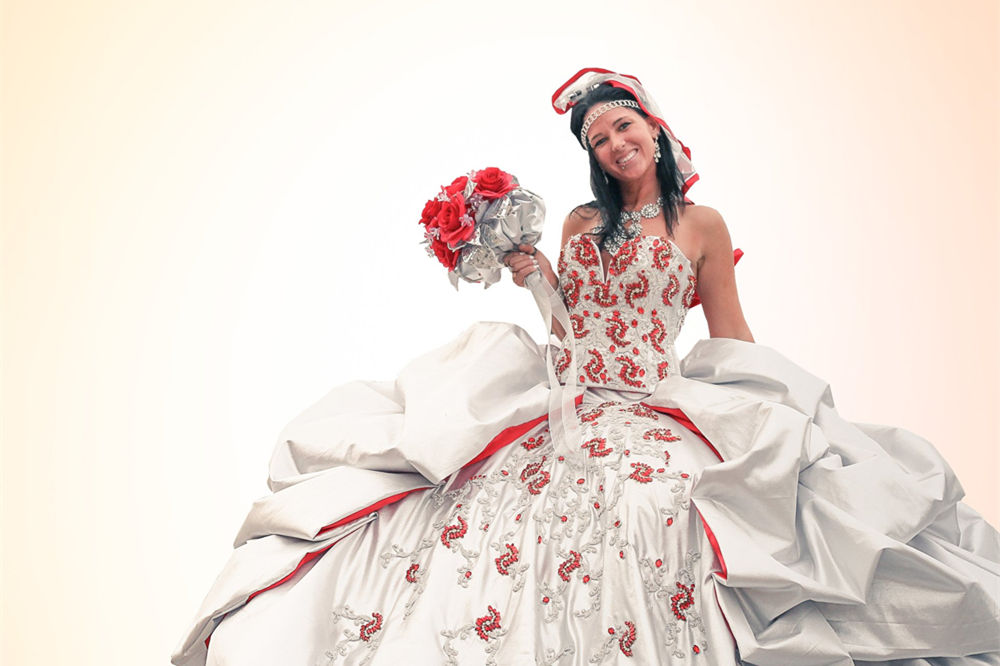
The designs were intentionally dramatic. Many included large structured skirts, fitted corset-style bodices, long trains, bright fabrics, oversized bows, feathers, flowers, metallic material, and thousands of sparkling stones. Matching crowns, shoes, bouquets, jewelry, and other accessories often completed the look.
The gowns were not limited to traditional white bridal styles. Brides and families requested bold colors and highly personal themes, leading to outfits inspired by candy, flowers, holidays, animals, or particular symbols. The goal was usually to create an entrance that guests would immediately remember.
A TLC gallery of dresses from the program shows the amount of detail involved. One ensemble combined a lace-up bodice and gold trim with a crystal rose pattern made from clear, turquoise, and topaz-colored stones. The outfit also included coordinated shoes, jewelry, a crown, a garter, and a bouquet.
Producing such large dresses created practical challenges. Internal structures had to support the skirts, decorative stones had to be attached securely, and the finished outfit still needed to fit through doors and allow the wearer to walk or dance.
Celli’s designs gave the series a consistent visual identity. Even when an episode introduced an entirely new family, the dress consultation and final reveal offered viewers a familiar part of the program.
Recurring Families, Brides, and Personalities
My Big Fat American Gypsy Wedding did not have a fixed cast in the traditional sense. Most families appeared because they were planning a particular wedding, birthday, or religious celebration. Once that event was over, the following episode usually moved to different participants.
However, some families returned and developed longer storylines. Members of the Stanley family became particularly prominent during the first season. Nettie Stanley, Mellie Stanley, Kayla Williams, and other relatives appeared in stories involving relationships, family loyalty, marriage, and conflicts between sisters.
Their popularity led TLC to produce the reunion specials The Stanley Sisters and The Aftermath. The specials revisited events from the season and allowed family members to respond to earlier disagreements.
The Stanley family later became central to Gypsy Sisters, a spinoff that premiered on TLC in February 2013. That series concentrated on Nettie, Mellie, and their extended family in and around Martinsburg, West Virginia. Rather than introducing unrelated families every week, it followed the sisters’ relationships and disputes across multiple episodes.
Sondra Celli provided another connection between different seasons. Because she created clothing for numerous participants, her design studio appeared even when the families and locations changed.
Was My Big Fat American Gypsy Wedding Real or Staged?
The program featured real people, families, relationships, and celebrations, but viewers did not necessarily see events exactly as they occurred away from the cameras.
Reality television is shaped by casting choices, filming schedules, interview questions, narration, editing, and decisions about which moments deserve the most attention. A lengthy family situation may be reduced to a few scenes, while a brief disagreement can become the central conflict of an episode.
Participants may also be asked to repeat an entrance, conversation, or action so it can be filmed clearly. Producers can arrange interviews or encourage people to discuss particular subjects, even when the words ultimately spoken belong to the participants.
Priscilla Kelly, who appeared in the first-season episode “14 and Looking for Mr. Right,” later said that her storyline did not accurately represent her upbringing. In a 2019 interview about her experience, she said the program made it appear that she was seeking a husband at 14, which she described as untrue.
Kelly’s experience does not establish that every wedding, celebration, or relationship shown on the series was invented. It does demonstrate why individual storylines should not automatically be accepted as complete records of the participants’ lives.
The most accurate description is that the show combined genuine people and events with reality television production. Some moments may have happened naturally, while others were simplified, repeated, rearranged, or emphasized to create a more dramatic episode.
Why the Show Was So Controversial
Different Communities Were Grouped Together
One major criticism concerned the way the program placed people from several backgrounds under the broad identity used in its title.
Roma, Romanichal people, Irish Travellers, and other Traveller populations have different origins and histories. Traditions can also vary between countries, regions, families, and generations. A rule followed by one household cannot automatically be treated as a practice shared by everyone from a similar background.
The Council of Europe uses “Roma and Travellers” as an umbrella term that includes a wide range of distinct groups, including Roma, Sinti, Romanichals, Travellers, Yenish people, and others. Its definition emphasizes that the term covers considerable diversity rather than one shared culture.
The television series did not always make those distinctions clear. Because each episode presented family statements alongside authoritative narration, viewers could reasonably assume that a personal belief represented a universal community rule.
Critics Said It Reinforced Stereotypes
The series repeatedly emphasized early marriage, strict expectations for women, revealing party outfits, extravagant spending, family feuds, and physical confrontations. Those subjects made dramatic television, but they also created a narrow picture of the people being filmed.
A study of Romani representation in the American series argued that reality television conventions repackaged stereotypes as authentic ethnic culture. The program’s focus on spectacle could make behavior selected for its entertainment value appear typical of an entire minority population.
Ordinary experiences received far less attention. Work, education, quieter family relationships, cultural differences, and the lives of people who did not fit the program’s preferred storylines were rarely central to an episode.
The British franchise also faced formal criticism. In 2012, the UK Advertising Standards Authority ruled that advertisements for the British Big Fat Gypsy Weddings reinforced negative cultural stereotypes. The ruling concerned the British program’s promotional campaign rather than TLC’s American series, but it illustrates the broader objections surrounding the franchise’s presentation of Roma and Traveller people.
Families who appeared on the American show made their own decisions to participate, and several returned for later episodes or spinoffs. The controversy was not simply about whether individual participants approved of being filmed. It concerned the impression created when a small group of highly dramatic stories was presented as access to a much larger cultural world.
The Language in the Title
The word “Gypsy” should be retained when accurately giving the program’s official title. It should not, however, automatically be applied to every person or community discussed in relation to the show.
Some individuals and groups use the word when describing themselves. Many Roma consider it offensive because of its association with centuries of prejudice, exclusion, and harmful stereotypes. The European Roma Rights Centre’s terminology guidance recommends using more accurate community names rather than assuming that one label is acceptable to everyone.
When a person’s identity is known, specific terms such as Roma, Romanichal, or Irish Traveller are clearer. “Roma and Traveller communities” can be used when discussing several populations together, provided the wording does not suggest that they all share the same customs.
What Happened to the Show and Where Can You Watch It?
The most recent episodes of My Big Fat American Gypsy Wedding were released in 2018. Discovery+ identifies the program as a six-season series, and no later season currently appears in its catalog.
The sixth season continued many of the show’s established themes, including relationships between community members and outsiders, parental objections, family disputes, and the return of members of the Stanley family. Its eight listed episodes also included a funeral and a same-sex wedding, showing that later installments extended beyond the program’s original wedding formula.
As of July 2026, the series is available in the United States through Discovery+, HBO Max, and Hulu. TLC also maintains a page for the show through its streaming platform.
Available episodes may vary according to location, subscription, and service. Because streaming catalogs change, viewers should check the current season listings on their chosen platform before subscribing.
Featured Image Source: go.tlc.com