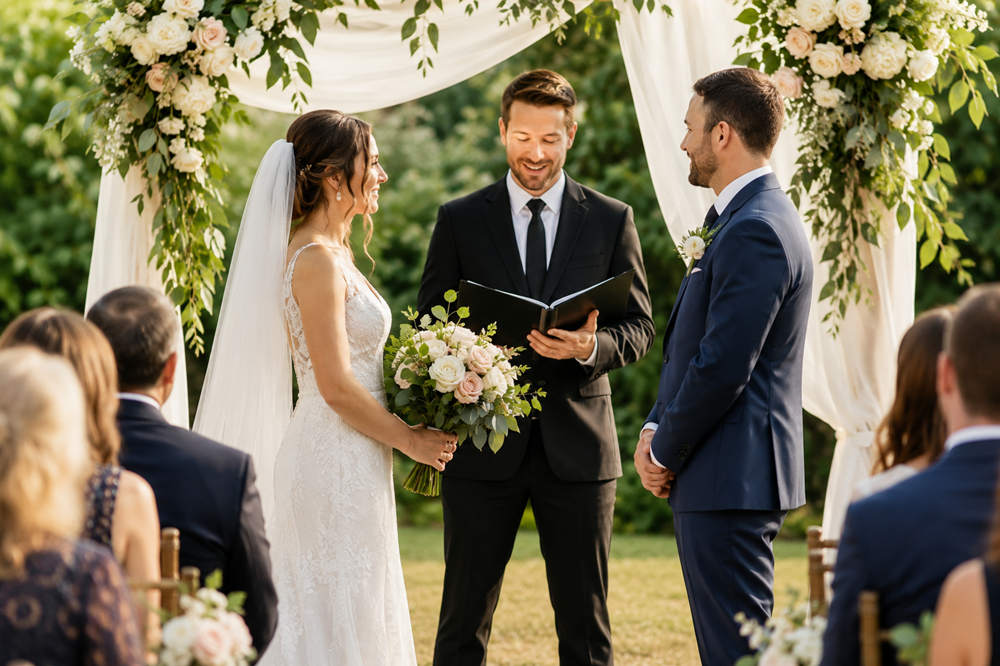
How to Officiate a Wedding: Legal Steps, Ceremony Order, and Script
Being asked to officiate a wedding is both an honor and a serious responsibility. You are not simply giving a speech. You are guiding the couple through an important ceremony and, in many places, helping complete the legal process that records their marriage.
A successful officiant prepares in stages. First, confirm that you are legally permitted to perform the ceremony. Then meet with the couple, establish the ceremony order, write the script, rehearse the movements, and complete the marriage license afterward.
You do not need to be a polished public speaker. Careful preparation, clear directions, and a sincere connection with the couple matter much more.
Check Whether You Can Legally Officiate the Wedding
Confirm your legal authority before writing the ceremony. Marriage laws usually depend on where the wedding will take place, not where the couple or officiant normally lives.
Some jurisdictions recognize clergy members, judges, government officials, or people ordained by qualifying religious organizations. Others offer temporary appointments or one-day officiant licenses for friends and relatives performing a specific marriage.
Do not assume that an online ordination will be accepted everywhere. Even when your ordination is recognized, you may need to register, present credentials, or complete an application before the wedding.
Contact the office responsible for marriage licenses in the ceremony location. Depending on the jurisdiction, this may be a county clerk, town clerk, city clerk, probate court, recorder, or vital records office. The state and local government directory can help you find the correct official website.
Ask the office to confirm:
- Who may legally perform a marriage
- Whether your ordination or credentials are recognized
- Whether advance registration is required
- Whether temporary authorization is available
- What identification or documents you must provide
- How many witnesses are required
- Whether the couple must use particular consent language
- Whether the license can be used at the chosen ceremony location
Local rules can be surprisingly specific. For example, people performing ceremonies within the five boroughs of New York City generally must complete marriage officiant registration with the City Clerk unless a particular exemption applies.
Complete any required authorization well before the wedding. Ask the clerk how long approval normally takes rather than relying on a general online estimate.
Meet With the Couple
Once your legal role is settled, schedule a detailed conversation with the couple. The purpose of this meeting is to understand the ceremony they want and collect the information needed to make it personal.
Begin with the overall tone. Ask whether they imagine something formal, relaxed, humorous, romantic, spiritual, secular, religious, or culturally traditional. Discuss the expected length and whether guests will participate through readings, prayers, music, or symbolic rituals.
Four questions can provide most of the material you need:
- How did you meet, and what brought you closer?
- What do you admire most about each other?
- Which experiences have shaped your relationship?
- What does marriage mean to each of you?
Ask which stories are appropriate to share publicly. A memory that feels amusing among close friends may be uncomfortable in front of relatives, colleagues, or children. Avoid discussing past relationships, private conflicts, or sensitive family matters unless the couple specifically asks you to include them.
Confirm practical details before the meeting ends:
- Full names, preferred names, and pronouns
- Correct pronunciations
- The planned ceremony length
- Whether the couple will write personal vows
- Any readings, blessings, or rituals
- The names of other participants
- How the couple wants to be introduced after the ceremony
Keep organized notes and ask the couple to approve any story or wording that could be sensitive.
Decide on the Wedding Ceremony Order
A wedding ceremony can be customized, but it still needs a clear sequence. Establishing the order first makes the script easier to write and gives the wedding party, readers, musicians, and vendors a shared plan.
A common ceremony order is:
- Processional
- Welcome and opening remarks
- Reading, blessing, prayer, or reflection
- Officiant’s address or the couple’s story
- Declaration of intent
- Exchange of vows
- Exchange of rings
- Optional unity or cultural ritual
- Pronouncement of marriage
- First kiss
- Presentation of the couple
- Recessional
Not every ceremony needs every element. A short elopement might include only a welcome, consent, vows, rings, and pronouncement. A traditional religious ceremony may include several prayers, readings, blessings, or community responses.
Arrange optional elements according to their purpose. Readings usually fit naturally before the vows, while a unity ritual often follows the exchange of rings. The pronouncement and kiss should remain near the end so the ceremony builds toward a clear conclusion.
Write a Personal Wedding Ceremony Script
The script should sound natural when spoken aloud. Use clear sentences, familiar vocabulary, and a tone that suits both you and the couple. Elaborate language is not necessary for the ceremony to feel meaningful.
Begin With a Concise Welcome
Welcome the guests and briefly acknowledge why everyone has gathered. You may thank family members for their support or recognize guests who traveled, but avoid turning the opening into a long list of acknowledgments.
The first few lines should establish warmth and direct attention toward the couple.
Share a Focused Version of the Couple’s Story
Select two or three details that show what makes the relationship distinctive. You might describe how the couple first connected, a quality they value in each other, or the kind of life they have built together.
Represent both partners equally. The address should not become a biography of one person or a series of jokes at the other person’s expense.
Choose stories that guests can understand without extensive background information. A brief, meaningful example usually has more impact than a complete timeline of the relationship.
Write Clear Transitions
Every major element should have a short introduction. Transitions prevent awkward pauses and quietly tell participants what to do next.
Before a reading, introduce the reader and the selection. Before the vows, explain that the couple will now express their promises. Before the rings, describe their symbolic purpose in one or two sentences.
Stage directions can be added to your printed script in bold or brackets, such as:
- [Ask guests to sit]
- [Couple turns toward each other]
- [Receive the rings]
- [Step aside before the kiss]
Distinguish Consent From Personal Vows
Many ceremonies include a declaration of intent in which each person clearly agrees to enter the marriage. It is often presented as an “I do” question, although laws do not always require that exact phrase or a separate traditional exchange.
Personal vows serve a different purpose. They express the promises the couple wishes to make about their future together.
Confirm whether the jurisdiction requires a clear statement of present consent or other particular wording. Once the legal requirement is understood, the couple can personalize the surrounding language.
Prepare the Pronouncement
The pronouncement is the officiant’s formal declaration that the couple is married. Keep it short and confident.
Ask whether the couple prefers traditional terms, gender-neutral language, or simply their names. You should also confirm the wording of their presentation after the kiss, especially when surnames are changing or remaining separate.
Coordinate the Practical Ceremony Details
Before the rehearsal, speak with the couple, planner, or venue coordinator about how the ceremony will operate in the space.
Confirm where you will enter, where you will stand, and where you should go after the recessional. Ask whether the ceremony will use a handheld microphone, lapel microphone, standing microphone, or no amplification.
Your clothing should match the wedding’s level of formality without drawing attention away from the couple. Ask about the dress code and wedding colors. Neutral, understated clothing generally photographs well, but the couple’s preference should guide the choice.
Format the script for easy reading:
- Use a large, legible font
- Leave generous spacing between paragraphs
- Place stage directions where they are easy to see
- Avoid page breaks during vows or the pronouncement
- Number the pages
- Bring a printed backup if you plan to use a device
Decide who will hold the rings, vow books, and any ritual items. Give each object to a specific person rather than assuming someone will take responsibility.
Tell the photographer where you will stand and confirm when you plan to move aside for the first kiss. This small adjustment creates a cleaner photograph of the couple.
Lead or Attend the Wedding Rehearsal
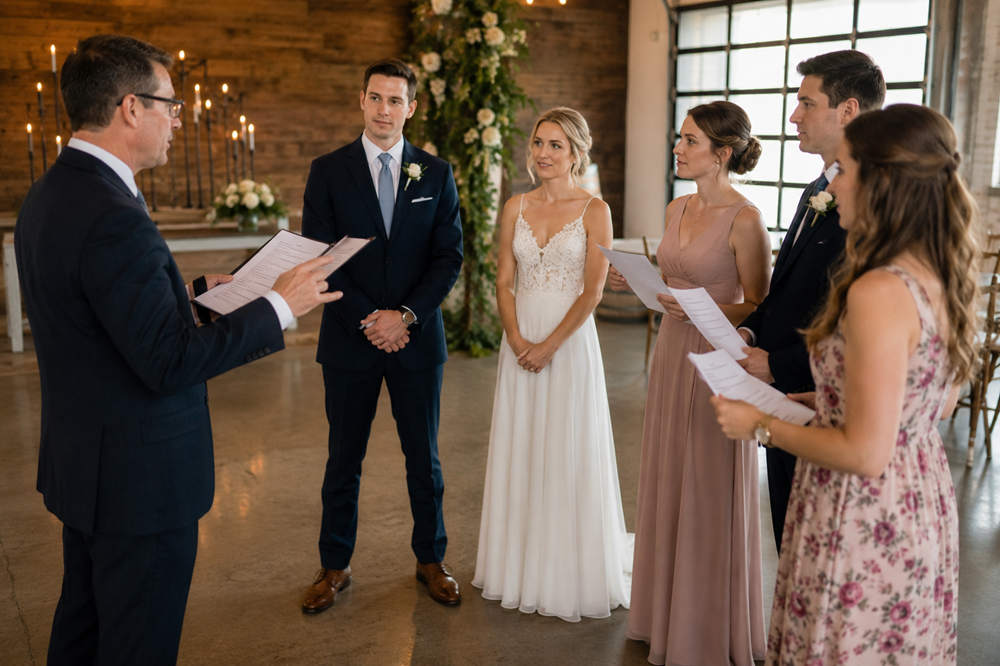
The rehearsal is for movement, placement, and timing. You do not need to deliver the complete ceremony or reveal all of your personal remarks.
Begin by placing the officiant, couple, wedding party, and readers in their correct positions. Make sure everyone knows where to stand, where to look, and when to move.
Practice:
- The processional order and walking pace
- The couple’s positions during the ceremony
- When guests should stand and sit
- Reader and musician cues
- The transfer of rings and vow books
- When the couple should join hands or face each other
- The first-kiss cue
- The recessional order
Test the microphone while everyone is standing in their actual ceremony positions. The couple should practice speaking toward it without turning completely away from the guests.
Read only the lines needed to demonstrate timing. Saving the personal address and full vows for the wedding helps the ceremony feel fresh and emotional.
How to Officiate the Ceremony on the Wedding Day
Arrive early and check in with the person managing the ceremony. Give yourself enough time to become comfortable in the space without feeling rushed as guests arrive.
Inspect the Marriage License
Ask to see the marriage license before performing the ceremony. Confirm that:
- It belongs to the correct couple
- The names are spelled correctly
- It remains valid on the wedding date
- It can be used in the ceremony location
- The required witness spaces are understood
- The completion and return instructions are clear
Some jurisdictions explicitly require the officiant to review the license before the marriage is solemnized. California, for example, includes this duty in its official marriage officiant guidance.
Contact the issuing office if important information appears incorrect. Do not assume that handwritten alterations will be accepted.
Speak Slowly and Naturally
Nervous speakers often move too quickly. Slow your normal speaking pace slightly and pause at the end of important sentences.
Look toward the guests during the welcome and toward the couple when speaking directly to them. Glance at the script when needed, but avoid reading every line with your eyes fixed on the page.
Give the Couple Clear Cues
The couple may be emotional or distracted, even after a thorough rehearsal. Use quiet, direct instructions when they need to turn, join hands, begin their vows, exchange rings, or prepare for the kiss.
A calm officiant makes these instructions feel like a natural part of the ceremony rather than a correction.
Handle Unexpected Moments Calmly
A person may forget a line, begin crying, laugh unexpectedly, or place a ring on the wrong hand. Pause and allow the moment to settle.
If someone loses their place during repeat-after-me vows, calmly offer the line again. There is rarely a reason to apologize to the guests or announce that something has gone wrong.
After the pronouncement, step to the side before inviting the couple to kiss. Return afterward to present them using their chosen names.
Complete and Return the Marriage License
After the ceremony, complete the portions of the marriage license assigned to you. Follow the form’s instructions rather than relying on a generic example, because the required fields differ between jurisdictions.
Enter the date and location accurately, use your proper legal name and officiant title, and make sure all required signatures are present. Review the witness sections before anyone leaves.
If you make an error, contact the issuing clerk for instructions. Do not cross out information or use correction fluid unless the office specifically directs you to do so.
Return the original document using the method and address provided by the issuing office. Deadlines can be brief. California generally requires the officiant to return the license within 10 days, while New York officiant responsibilities include returning it within five days. Other jurisdictions follow different timelines.
Use any return envelope supplied by the clerk. When no specific mailing method is required, proof of mailing or delivery can help show that the document was sent on time.
Keep a copy of the completed document only when permitted and with the couple’s consent. Marriage licenses contain personal information that should be handled carefully.
Remind the couple that the license and the certified marriage certificate are not necessarily the same document. The license authorizes and records the marriage process, while a certified certificate is usually obtained after the marriage has been registered. The couple may need certified copies for insurance, benefits, immigration matters, or a legal name change.
Simple Wedding Ceremony Script Template
Important: This template provides a general ceremonial structure. It does not guarantee compliance with the consent, witness, registration, or license rules in a particular jurisdiction. Confirm the local requirements before using it.
Welcome
“Welcome, everyone. We are gathered here today to celebrate the marriage of [Name] and [Name]. Thank you for being here to support them as they begin this new chapter together.”
Opening Reflection
“Marriage is shaped not only by the promises made today, but also by the choices made in the years ahead. It grows through honesty, patience, laughter, respect, and the willingness to face life as a team.”
The Couple’s Story
“[Name] and [Name] first met [brief description]. As their relationship grew, they discovered a shared commitment to [values, experiences, or goals]. Today, they have chosen to continue building their life together through marriage.”
Declaration of Intent
“[Name], do you freely choose [Name] as your partner in marriage, promising to love, respect, and stand beside them through the life you will share?”
“I do.”
Repeat the question for the other partner.
Vows
“[Name] and [Name] will now share the promises they have chosen to make to one another.”
For repeat-after-me vows:
“I, [Name], choose you, [Name], as my partner. I promise to respect you, support you, laugh with you, and stand beside you through whatever life brings.”
Ring Exchange
“These rings are visible reminders of the promises you have made today.”
“Please place the ring on [Name]’s finger and repeat after me: I give you this ring as a symbol of my love and my commitment to you.”
Pronouncement
“[Name] and [Name], you have expressed your consent, shared your promises, and exchanged rings in the presence of those who care for you. By the authority granted to me under the laws of [jurisdiction], I now pronounce you married.”
First Kiss and Presentation
“You may kiss.”
After the kiss:
“It is my honor to present [the couple’s chosen introduction].”
Final Thoughts
A meaningful wedding ceremony does not depend on theatrical delivery or complicated language. It comes from understanding the couple, preparing each part carefully, and guiding the ceremony with warmth and confidence.
Verify your legal authority early, create a clear ceremony order, rehearse the physical cues, and speak at a calm pace on the wedding day. Afterward, complete the license accurately and return it promptly.
When both the personal and legal details are handled with care, you can give the couple a ceremony that feels genuine, organized, and entirely their own.