What Hand Does an Engagement Ring Go On? Traditions and Modern Choices
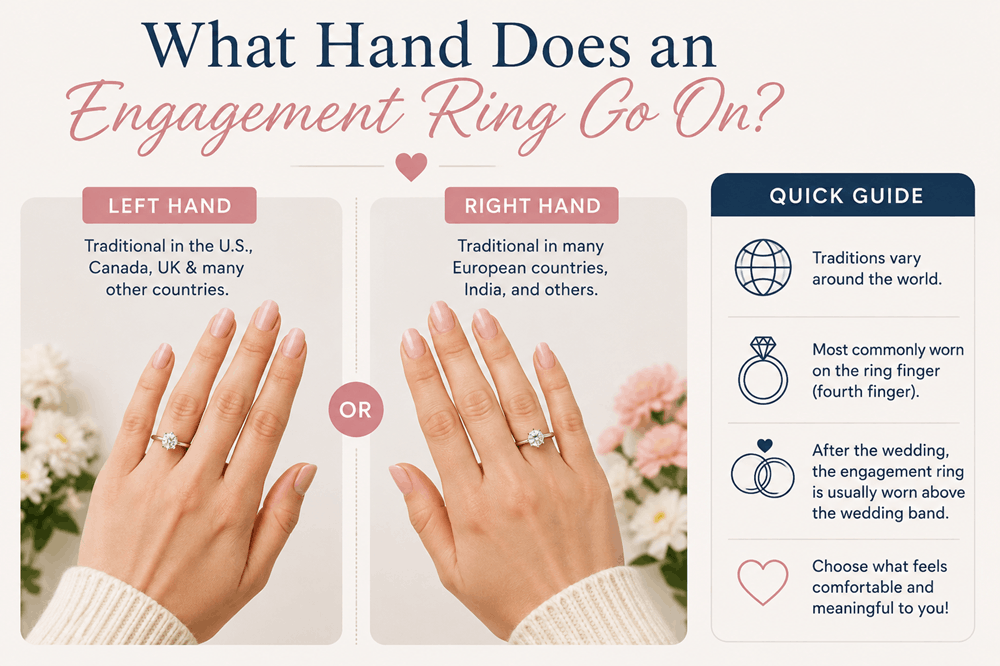
An engagement ring traditionally goes on the ring finger of the left hand in the United States, Canada, the United Kingdom, Australia, and several other countries. The ring finger is the fourth finger when counting from the thumb.
However, this is not a universal rule. In many cultures, engagement rings are worn on the right hand. Personal comfort, religion, family tradition, occupation, and plans for the wedding band can all influence where someone chooses to wear the ring.
There is no legally required hand or finger for an engagement ring. The correct choice is the one that feels meaningful and practical to the person wearing it.
Which Finger Is the Engagement Ring Finger?
The engagement ring finger is usually the fourth finger of the left hand. It sits between the little finger and middle finger.
People sometimes count fingers differently, which can create confusion. Starting with the thumb:
- Thumb
- Index finger
- Middle finger
- Ring finger
- Little finger
The ring finger received its familiar name because of its long association with engagement and wedding jewelry. In places where rings are traditionally worn on the right hand, the fourth finger of that hand serves the same purpose.
Why Does an Engagement Ring Go on the Left Hand?
One popular explanation connects the tradition to an ancient belief in the vena amoris, or “vein of love.” According to the story, people once believed that a vein ran directly from the fourth finger of the left hand to the heart.
Modern anatomy does not support this idea. The veins in the ring finger connect through the same broader circulatory system as those in the other fingers. There is no single vein running exclusively from that finger to the heart.
Even though the explanation is symbolic rather than anatomically accurate, the image remains romantic. The ring finger continues to represent love, devotion, and a direct emotional connection between partners.
Custom also reinforces itself over time. Once left-hand ring wearing became widely recognized in certain societies, couples continued following it because family members, jewelers, and other married people did the same.
What Countries Wear Engagement Rings on the Left Hand?
Left-hand engagement rings are common in countries including:
- The United States
- Canada
- The United Kingdom
- Australia
- New Zealand
- France
- Italy
- Ireland
- Mexico
- South Africa
Practices can still vary within each country. Regional customs, religious traditions, family preferences, and multicultural relationships may lead someone to wear the ring differently.
A person living in the United States, for example, may follow a family tradition from another country and wear the engagement ring on the right hand. Another person may wear it on the left simply because that is what feels familiar.
What Countries Wear Engagement Rings on the Right Hand?
Right-hand ring traditions are common in parts of Europe, South America, and other regions.
Countries and communities where the right hand may be used include:
- Germany
- Austria
- Poland
- Russia
- Greece
- Norway
- Denmark
- India
- Brazil
- Chile
The exact custom is not identical everywhere. In some traditions, a person wears the engagement ring on one hand and moves it to the other during or after the wedding ceremony.
For example, an engagement ring may begin on the right hand and later move to the left. In another community, the wedding band may remain permanently on the right hand.
When cultural tradition matters to the couple, they may want to ask parents, grandparents, religious leaders, or married relatives how rings are normally worn in their community.
Which Hand Does the Engagement Ring Go On Before Marriage?
Before marriage, the engagement ring normally goes on the finger associated with engagement in the wearer’s culture.
For many American couples, that means the left ring finger. The ring stays there throughout the engagement, except when it is removed for cleaning, repairs, exercise, work, sleep, or another practical reason.
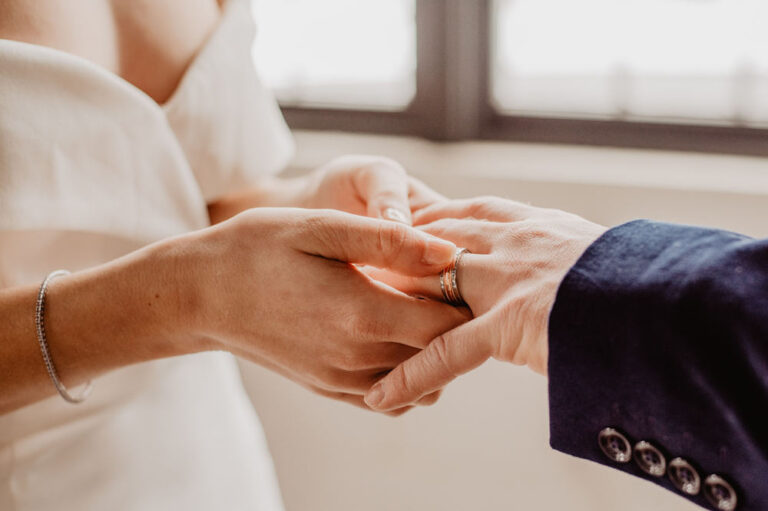
Someone who intends to wear both an engagement ring and wedding band on the same finger has several choices on the wedding day. The engagement ring may temporarily move to the right hand so the wedding band can be placed directly on the left ring finger during the ceremony.
Afterward, the engagement ring is moved back and placed above the wedding band.
What Happens to the Engagement Ring During the Wedding Ceremony?
There is no single required method. Common options include:
Move it to the right hand
Before the ceremony, the person moves the engagement ring to the right ring finger. This leaves the left ring finger open for the wedding band.
After the ceremony, the engagement ring is returned to the left hand and placed above the wedding band.
Leave it on the left hand
The wedding band may be placed above the engagement ring during the ceremony. The rings can be rearranged afterward.
This option is simple, although the officiant or partner may need to place the band over a raised engagement-ring setting.
Ask someone to hold it
A maid of honor, parent, sibling, or trusted attendant can hold the engagement ring until after the ceremony.
Because engagement rings are valuable and easy to misplace, this approach should be planned carefully. The ring should be kept in a secure box or pouch rather than carried loosely.
Wear it on another finger
The engagement ring may temporarily be worn on a different finger if it does not fit comfortably on the right hand.
Keep the final arrangement during the ceremony
Some couples place the wedding band above the engagement ring and leave the rings in that order. Symbolism is personal, and no rule requires the band to sit closer to the hand.
Does the Wedding Band Go Above or Below the Engagement Ring?
The wedding band is traditionally worn below the engagement ring, placing it closer to the hand and, symbolically, closer to the heart.
The usual order from the base of the finger upward is:
- Wedding band
- Engagement ring
- Optional anniversary or stacking ring
This arrangement is traditional rather than mandatory.
Some engagement-ring settings sit more comfortably below the wedding band. Others have curved or contoured bands designed for a particular order. A person may also prefer the appearance of the engagement ring first and wedding band second.
Comfort and security should take priority. If one order causes the rings to rub, spin, pinch, or damage each other, a jeweler may recommend a different arrangement.
Can You Wear an Engagement Ring on the Right Hand?
Yes. An engagement ring can be worn on the right hand for cultural, practical, or personal reasons.
Someone may choose the right hand because:
- It follows a cultural tradition.
- The left ring finger already holds another meaningful ring.
- The ring fits more comfortably on the right hand.
- The wearer is left-handed and wants to protect the ring.
- The engagement ring and future wedding band will be worn separately.
- The wearer simply prefers how it looks.
Wearing the ring on the right hand does not make the engagement less official. People who know the wearer may still recognize its meaning, especially when the ring has a traditional engagement design.
Does Being Left-Handed Change Which Hand You Should Use?
A left-handed person may prefer wearing an engagement ring on the right hand to reduce scratching, impact, and interference during everyday activities.
The dominant hand is often used more frequently for writing, cooking, opening doors, carrying objects, and handling tools. A raised diamond setting may catch on clothing or strike hard surfaces more often when worn on that hand.
However, many left-handed people comfortably follow the traditional left-hand custom. A low-profile setting, smooth band, bezel-set stone, or protective work ring can make everyday wear easier.
The wearer should consider lifestyle rather than assuming the traditional hand is automatically best.
What Hand Does a Man Wear an Engagement Ring On?
A man can wear an engagement ring on the same finger traditionally used by anyone else: the fourth finger of the left hand in many Western countries.
He may also wear it on the right hand, especially when:
- That placement follows his culture.
- He plans to use the engagement ring as his wedding band.
- He wants to reserve the left hand for a different wedding ring.
- His work makes one hand safer than the other.
- He prefers the appearance or comfort of the right hand.
A men’s engagement ring may be a simple band, signet-style ring, diamond band, gemstone ring, or decorative design. The wearer’s gender does not create a separate rule for ring placement.
What Hand Does an Engagement Ring Go On for Same-Sex Couples?
Same-sex couples can follow any tradition that feels appropriate.
Both partners may wear rings on the left hand, both may use the right hand, or each person may choose a different hand. They may exchange matching rings, select individual designs, or use the engagement rings as their eventual wedding bands.
Couples may consider:
- Family traditions
- Cultural expectations
- Personal comfort
- Workplace safety
- How engagement and wedding rings will be combined
- Whether matching placement feels important
There is no need to recreate traditional gender roles. The rings can reflect the actual people and relationship being celebrated.
Can an Engagement Ring Go on Any Finger?
Yes. An engagement ring can technically be worn on any finger, although placing it on the traditional ring finger makes its meaning easier for other people to recognize.
A different finger may be more comfortable when:
- The ring cannot be resized.
- The wearer has arthritis or swelling.
- Another meaningful ring occupies the ring finger.
- The setting interferes with work.
- The ring is an heirloom with a fixed size.
- The wearer prefers an unconventional style.
Some people wear engagement rings on necklaces instead of fingers. This may be safer for healthcare workers, mechanics, athletes, musicians, chefs, and people who regularly use machinery.
Should You Wear an Engagement Ring Every Day?
You can wear an engagement ring every day, but it does not need to remain on your hand at all times.
Consider removing it during:
- Heavy lifting
- Contact sports
- Gardening
- Cleaning with harsh chemicals
- Swimming
- Showering
- Cooking with sticky dough or raw meat
- Applying lotion
- Sleeping, when the setting catches on fabric
- Work involving machinery
Removing the ring helps protect the setting, metal, and center stone. It may also prevent finger injuries.
Keep a secure ring dish or jewelry box in the places where the ring is commonly removed. Avoid placing it on a sink edge, inside a pocket, or loosely on a countertop.
What If the Engagement Ring Does Not Fit the Traditional Finger?
Do not force a ring onto a finger or continue wearing one that is painfully tight.
Finger size can change because of:
- Heat
- Cold
- Pregnancy
- Medication
- Temporary swelling
- Weight changes
- Arthritis
A jeweler can determine whether the ring can be resized. Plain gold and platinum rings are often easier to adjust than bands made from certain hard metals or designs with stones around the entire circumference.
Temporary ring adjusters can help when a ring is slightly loose, but they should not replace professional resizing when the fit is significantly wrong.
Can You Switch Hands After Marriage?
Yes. Some people change hands after the wedding because of culture, comfort, or the arrangement of their rings.
Possible choices include:
- Wearing the wedding band and engagement ring together on the left hand
- Moving the engagement ring to the right hand
- Wearing only the wedding band daily
- Saving the engagement ring for special occasions
- Combining both rings into a custom setting
- Alternating between hands
The meaning of the ring does not disappear when its placement changes.
What If You Do Not Want to Follow Tradition?
You do not have to.
An engagement ring can go wherever the wearer prefers. A couple may choose the right hand because it feels balanced, wear matching rings on different fingers, or avoid rings entirely.
Alternatives to a traditional engagement ring include:
- A necklace
- A bracelet
- A watch
- An heirloom piece
- A tattoo
- A meaningful shared purchase
- No physical symbol
Traditions can provide inspiration, but they should not create discomfort or conflict. A visible ring is only one way to represent a promise to marry.
Frequently Asked Questions
Does an engagement ring always go on the left hand?
No. The left hand is traditional in several Western countries, while the right hand is customary in many other cultures.
What finger does an engagement ring go on?
It generally goes on the fourth finger, commonly called the ring finger.
Can you wear the engagement ring on your right hand before marriage?
Yes. You may wear it on the right hand because of culture, comfort, occupation, or personal preference.
Where does the engagement ring go after the wedding?
It is often worn above the wedding band on the same finger. It may also move to the other hand or be saved for special occasions.
Which ring goes on first after marriage?
Traditionally, the wedding band goes on first and the engagement ring sits above it.
Do men and women use different engagement-ring hands?
No. The traditional hand is generally based on culture rather than gender.
Can you wear an engagement ring on a necklace?
Yes. This can be practical for someone who cannot safely or comfortably wear a ring on a finger.
Is it bad luck to wear an engagement ring on the wrong hand?
No. Ring placement is a custom, not a rule that affects the relationship or marriage.
Choose the Hand That Fits Your Tradition and Daily Life
The traditional answer to what hand an engagement ring goes on is the fourth finger of the left hand, particularly in the United States and several other Western countries.
However, many people wear engagement rings on the right hand because of cultural customs, personal comfort, work, or plans for the wedding band. Others switch hands during the ceremony, wear the ring on a necklace, or choose a different finger entirely.
An engagement ring represents a commitment between two people. Its meaning comes from that promise, not from whether it is placed on the left or right hand.
Follow tradition when it feels meaningful, but choose a different placement when it better suits your culture, lifestyle, and personal style.