Average Engagement Ring Cost: What Couples Spend and How to Set a Budget
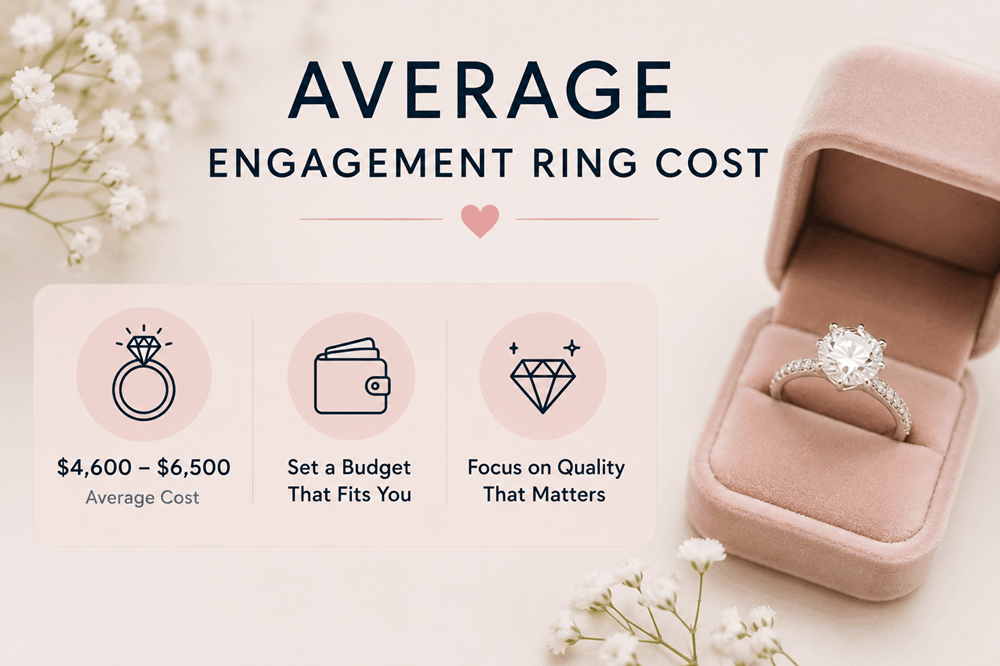
The average engagement ring cost in the United States currently falls somewhere between $4,600 and $6,500, depending on the study and the rings included. However, an average is only a reference point. A meaningful engagement ring may cost $800, $3,000, $10,000, or another amount that fits the couple’s preferences and financial situation.
The best budget is not based on a salary formula. It is an amount you can pay without neglecting bills, increasing stressful debt, or sacrificing more important shared goals.
What Is the Average Engagement Ring Cost?
The Knot’s 2025 Jewelry and Engagement Study reported that couples spent an average of approximately $4,600 on an engagement ring. BriteCo reported a higher 2025 average of $6,504 based on its own jewelry data.
These figures are not necessarily contradictory. Different studies examine different groups of buyers. A survey of recently engaged couples may include many modestly priced rings, while insurance and appraisal data may be more likely to include expensive jewelry that owners consider valuable enough to insure.
For practical planning, it is reasonable to say that the current average engagement ring costs roughly $4,600 to $6,500. Many buyers spend less, while luxury, custom, natural-diamond, and designer rings can cost considerably more.
| Ring budget | What it may offer |
|---|---|
| Under $1,000 | Simple gold bands, smaller lab-grown diamonds, moissanite, vintage rings, or alternative gemstones |
| $1,000–$3,000 | Quality lab-grown stones, smaller natural diamonds, classic settings, or distinctive gemstones |
| $3,000–$6,000 | A broad selection of diamond sizes, settings, metals, and custom details |
| $6,000–$10,000 | Larger stones, stronger natural-diamond options, premium settings, or designer rings |
| Over $10,000 | High-carat natural diamonds, rare gemstones, intricate custom work, or luxury-brand designs |
These ranges are general rather than guaranteed. Two rings with a similar appearance can have very different prices because of the stone’s origin, quality, certification, metal, and seller.
Why Do Engagement Ring Averages Vary So Much?
Engagement ring prices cover an unusually wide range. One person may purchase a vintage sapphire ring for $900, while another buys a custom natural-diamond ring for $25,000.
A small number of expensive purchases can pull an average upward. That means the average does not always describe what a typical shopper should expect to spend.
Price studies may also measure different things:
- The amount paid at the jewelry store
- The appraised replacement value
- The center stone without the setting
- The complete finished ring
- Natural diamonds only
- Natural and lab-grown diamonds together
- Only rings submitted for insurance
When comparing averages, check what the number represents. An appraisal value is often intended to estimate replacement cost and may be higher than the actual purchase price.
Natural Diamond vs. Lab-Grown Diamond Cost
The choice between a natural and laboratory-grown diamond is now one of the largest factors affecting an engagement ring’s price.
BriteCo’s 2025 research reported an average of approximately $10,760 for natural-diamond rings and $5,188 for lab-grown diamond rings within its data. Its more recent appraisal analysis reported a 2025 median sales price of $12,961 for natural-diamond engagement rings and $4,557 for lab-grown rings.
Those numbers should not be treated as required prices, but they illustrate how strongly diamond origin can affect the final cost.
A lab-grown diamond is a real diamond created in a controlled facility rather than formed naturally underground. It has essentially the same chemical composition and crystal structure as a natural diamond, although trained laboratories can identify differences in how it formed.
A buyer may choose a lab-grown diamond to obtain a larger stone or higher color and clarity grade within a limited budget. Another buyer may prefer the rarity, geological origin, or traditional appeal of a natural diamond.
Neither choice is automatically correct for every couple. The important point is to confirm how the stone is described and priced. The Federal Trade Commission advises shoppers to distinguish between natural, lab-created, and imitation stones and to obtain return policies and important promises in writing.
What Determines the Price of an Engagement Ring?
1. Carat weight
Carat measures a diamond’s weight rather than its visible size. Larger diamonds usually cost more, but the price does not increase evenly.
A 2-carat diamond may cost much more than twice the price of a 1-carat diamond because larger high-quality stones are less common.
Shopping slightly below popular full-carat weights may reduce the price. For example, a well-cut 0.90-carat diamond may look very similar to a 1-carat diamond after it is placed in a setting.
2. Cut quality
Cut affects how effectively a diamond interacts with light. A well-cut diamond can appear bright, lively, and visually impressive even when it is smaller than another stone.
The Gemological Institute of America identifies cut, color, clarity, and carat weight as the four main characteristics used to evaluate diamonds. GIA also notes that cut quality strongly affects a diamond’s brightness, fire, and sparkle.
Reducing cut quality simply to obtain a larger carat weight may result in a stone that looks dull. Many shoppers prefer to protect the cut grade and compromise slightly on another feature.
3. Color
Colorless diamonds generally cost more than stones with noticeable yellow or brown tones. However, small differences between nearby color grades may be difficult to see once a diamond is mounted.
The setting can also affect appearance. A slightly warmer diamond may look attractive in yellow or rose gold, allowing the buyer to select a lower color grade without feeling that the ring looks less beautiful.
4. Clarity
Clarity describes a diamond’s internal and external characteristics. Flawless stones are rare and expensive, but most engagement rings do not need the highest clarity grade to look clean to the unaided eye.
GIA’s clarity scale contains 11 grades, and most diamonds fall within the VS or SI ranges.
An “eye-clean” diamond with an inclusion that cannot be seen easily may provide better value than a technically flawless diamond whose difference is visible only under magnification.
5. Diamond shape
Round diamonds often carry higher prices because of demand and the amount of rough material lost during cutting.
Oval, pear, cushion, emerald, radiant, marquise, and princess-cut stones may offer a different appearance or larger face-up look for the budget.
Elongated shapes can also appear larger because they cover more of the finger.
6. Setting
A simple solitaire setting generally costs less than a design with a halo, pavé diamonds, hidden accents, or several side stones.
The setting price may include:
- Metal
- Labor
- Small accent stones
- Custom design work
- Engraving
- Special prongs or structural details
Ask whether the quoted price includes both the center stone and setting. Some retailers display them separately.
7. Metal
Common engagement ring metals include:
- 14-karat gold
- 18-karat gold
- Platinum
- White gold
- Yellow gold
- Rose gold
Platinum and 18-karat gold often cost more than 14-karat gold. However, the best choice should also consider durability, maintenance, allergies, and the wearer’s preferred color.
8. Brand and designer name
A luxury-brand ring may cost more than a visually similar ring from an independent jeweler. Part of the price may reflect branding, store experience, packaging, design exclusivity, and resale recognition.
Decide whether the name itself has value to you. A custom local jeweler may be able to create a comparable style at a different price.
How Much Should You Spend on an Engagement Ring?
You should spend an amount that fits comfortably within your real financial circumstances.
Consider:
- Monthly income
- Current savings
- Credit-card balances
- Student loans
- Housing costs
- Emergency savings
- Wedding expenses
- Honeymoon plans
- Home-buying goals
- The recipient’s expectations
A ring should symbolize a commitment, not create a financial problem that follows the couple into marriage.
For example, someone with $20,000 in savings, stable income, and no high-interest debt may comfortably spend $5,000. Another person earning the same income may have medical bills, childcare costs, or major loan payments and reasonably choose a $1,500 ring.
The lower-priced ring is not less meaningful.
Is the Three-Month Salary Rule Real?
No financial or etiquette authority requires someone to spend three months of salary on an engagement ring.
A salary-based formula ignores taxes, debt, savings, living costs, family responsibilities, and the couple’s priorities. Two people with the same salary may have completely different amounts available for jewelry.
Instead of multiplying income by a fixed number, work backward from what can be paid safely.
A practical approach is:
- Decide whether the ring will be paid for in cash or financed.
- Protect emergency savings.
- Pay essential bills and high-interest debt first.
- Discuss the recipient’s preferred style and stone.
- Set a maximum total, including taxes and resizing.
- Shop only within that range.
Should You Finance an Engagement Ring?
Financing can spread the cost across several months, but it can also make an expensive ring appear more affordable than it actually is.
Before accepting financing, review:
- Annual percentage rate
- Required monthly payment
- Loan length
- Late fees
- Deferred-interest terms
- Early-payment rules
- Total amount repaid
Buy-now-pay-later services are installment loans, even when they are advertised as simple payment plans. The Consumer Financial Protection Bureau advises consumers to understand how the payments work and how the purchase fits with other debt obligations.
A zero-interest plan can be useful when the balance will comfortably be paid before the promotional period ends. High-interest financing may cause the ring to cost considerably more than its sale price.
Hidden Costs to Include in the Budget
The displayed ring price may not be the final amount.
Plan for:
- Sales tax
- Shipping
- Resizing
- Engraving
- Diamond grading report
- Independent appraisal
- Jewelry insurance
- Future maintenance
- Prong inspection
- Professional cleaning
- Replacement of small accent stones
Ask whether the jeweler provides complimentary resizing, cleaning, inspections, or repair coverage. Read the conditions carefully, because some warranties require regular inspections.
How to Spend Less Without Choosing a Ring You Dislike
Choose a lab-grown diamond
This can provide a noticeably larger diamond within the same budget.
Consider moissanite or another gemstone
Moissanite, sapphire, ruby, morganite, and other stones can create a distinctive ring at a range of prices. Make sure the stone is durable enough for regular wear and clearly identified by the seller.
Shop just below a full-carat weight
A 0.90-carat or 1.90-carat stone may cost less than the next full-carat milestone while looking very similar.
Prioritize cut over invisible perfection
A bright, eye-clean diamond may look better than a larger stone with poor proportions.
Choose a simple setting
A solitaire emphasizes the center stone and usually costs less than a heavily decorated setting.
Consider vintage or estate jewelry
Pre-owned rings can provide distinctive craftsmanship, history, and value. Have the ring inspected and confirm the return policy before purchasing.
Compare several jewelers
Compare the complete specifications rather than price alone. The FTC recommends comparing quality, service, and price among several businesses before buying diamond jewelry.
Questions to Ask Before Buying
- Is the center stone natural, laboratory-grown, or a simulant?
- Does the price include the setting?
- Is there an independent grading report?
- What is the return period?
- Can the ring be resized?
- What maintenance is required?
- What does the warranty cover?
- Are custom orders refundable?
- What is the final price after tax and fees?
- How long will production or delivery take?
Get important promises, return rules, and stone descriptions in writing.
Frequently Asked Questions
What is the average engagement ring cost in 2026?
The most recent widely cited 2025 studies place the U.S. average between approximately $4,600 and $6,504, depending on the survey and methodology used.
Is $3,000 enough for an engagement ring?
Yes. A $3,000 budget can provide many attractive options, including lab-grown diamonds, smaller natural diamonds, moissanite, gemstones, vintage rings, and classic gold settings.
Is $1,000 too little?
No. A $1,000 ring can be beautiful and meaningful. Focus on design, durability, and the recipient’s preferences rather than comparing it with national averages.
Who usually pays for the engagement ring?
Traditionally, the person proposing pays, but modern couples may shop together, divide the cost, use shared savings, or exchange rings.
Should you insure an engagement ring?
Insurance may be worth considering when replacing the ring after theft, loss, or damage would create a serious financial burden. Review deductibles, exclusions, replacement procedures, and coverage limits before purchasing a policy.
Does a larger diamond always cost more?
Usually, but size is only one factor. A smaller diamond with exceptional cut, color, clarity, or rarity may cost more than a larger lower-grade stone.
Use the Average as Context, Not a Requirement
The average engagement ring cost gives shoppers a useful point of comparison, but it should never become a spending target.
Current studies place the average U.S. price somewhere around $4,600 to $6,500, while natural-diamond, lab-grown, gemstone, vintage, and custom rings can fall far above or below that range.
Begin with the amount you can genuinely afford. Then decide which qualities matter most to the person who will wear the ring—size, sparkle, origin, color, setting, symbolism, or family history.
A thoughtfully chosen ring that supports the couple’s financial wellbeing is more valuable than one purchased to satisfy an arbitrary salary rule or compete with someone else’s proposal.