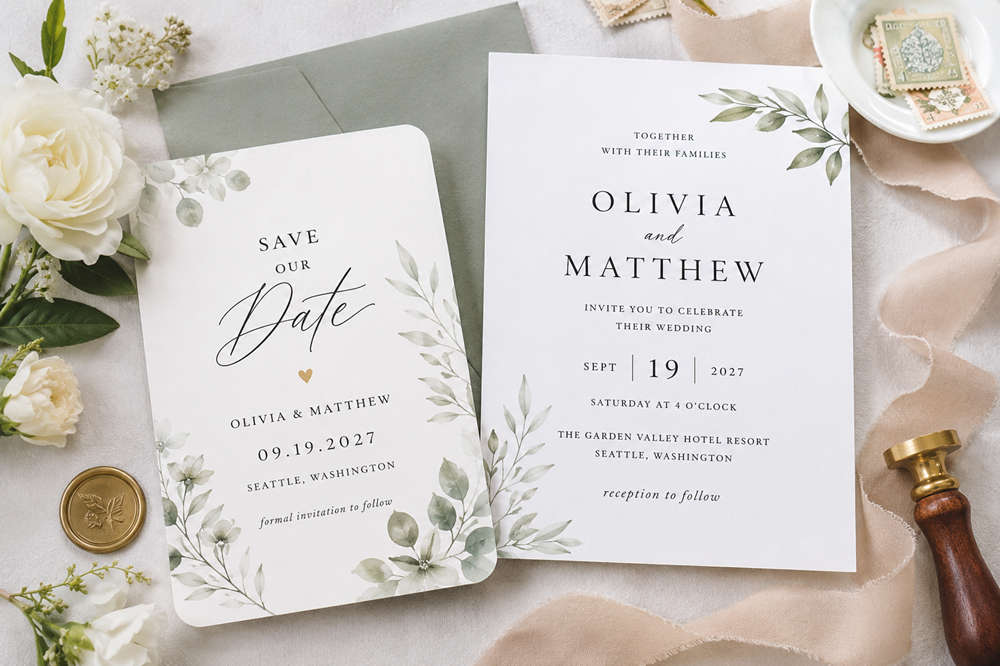
Save the Date vs. Invitation: What Is the Difference?
Save-the-dates and wedding invitations are sent at different stages of wedding planning. A save-the-date gives guests early notice of the date and general location. The invitation arrives later with the formal request to attend, confirmed event details, and instructions for responding.
Some couples send both, while others only need invitations. The right choice depends largely on how much advance planning the guests will require.
Save the Date vs. Invitation: The Main Difference
| Detail | Save-the-Date | Wedding Invitation |
|---|---|---|
| Primary purpose | Asks guests to keep the date available | Formally asks guests to attend |
| When it is sent | Several months before the wedding | Several weeks before the wedding |
| Information included | Date and general location | Time, venue, reception, and response details |
| RSVP required | Usually no | Usually yes |
| Formality | Often simple or playful | Reflects the formality of the wedding |
| Is it required? | Optional | Yes, although it may be printed or digital |
The two pieces complement each other, but one cannot normally replace the other. The first helps guests plan; the second gives them the information needed to decide and respond.
What Is a Save-the-Date?
A save-the-date is an early wedding announcement sent after the date and general location have been confirmed. It allows guests to reserve the day before the full ceremony and reception plans are ready to share.
This advance notice is particularly valuable for guests who may need to request time away from work, arrange childcare, book accommodations, or purchase flights.
A save-the-date usually includes:
- The couple’s names
- The wedding date or wedding weekend
- The city, state, or destination
- The wedding website, if it is ready
- A phrase such as “Invitation to follow”
The exact venue address, ceremony time, dress code, and RSVP deadline can wait until the invitation. Including too much unsettled information may create confusion if the plans are adjusted later.
A save-the-date generally does not ask for a response. Its purpose is to give notice rather than collect a final guest count. Couples should also wait until the guest list is firm before sending one, because recipients will reasonably expect to receive an invitation later.
What Is a Wedding Invitation?
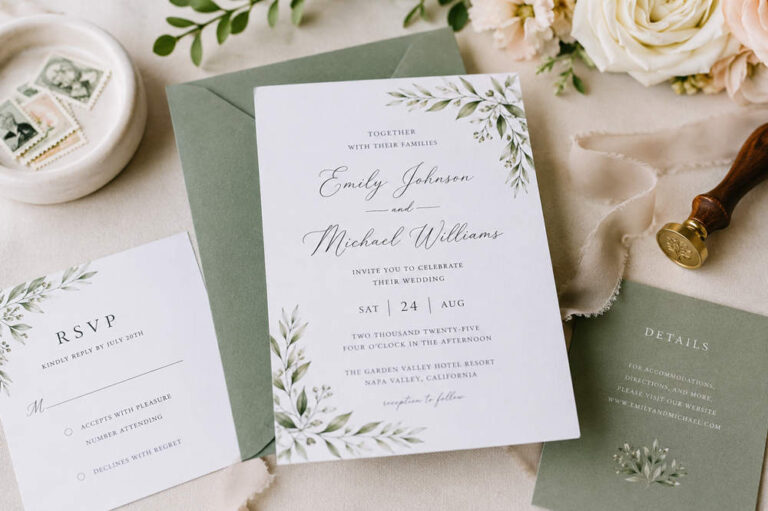
A wedding invitation is the formal request for a guest to attend the ceremony, reception, or both. It is sent after the event details have been confirmed.
The main invitation commonly includes:
- The names of the hosts or couple
- A request for the guest’s presence
- The wedding date
- The ceremony time
- The venue name and location
Reception information, accommodations, transportation, directions, and other practical details may appear on separate enclosure cards or the wedding website. Guests should also receive clear RSVP instructions, whether they are responding by mail or online.
Traditional and casual invitations contain the same essential information, but the language can differ. Formal wording may use phrases such as “the honour of your presence” for a ceremony in a house of worship or “the pleasure of your company” for another venue. More relaxed wording can use conversational language, shortened dates, and first names while remaining clear. The wedding invitation guidance from Emily Post provides examples of both approaches.
When to Send Each One
The timing should give guests enough notice without asking them to make a final commitment before they know their schedule.
When to Send Save-the-Dates
Many couples send save-the-dates six to nine months before a local wedding. This gives guests time to protect the date without requiring every part of the celebration to be finalized unusually early.
For a destination wedding, holiday weekend, or event that requires extensive travel, nine to twelve months is often more helpful. Earlier notice allows guests to compare transportation costs, reserve accommodations, arrange childcare, and request leave.
These are planning ranges rather than strict rules. Couples should consider how far guests must travel, how quickly local accommodations fill, and whether the wedding falls during a particularly busy season. Current save-the-date timing guidance supports a six-to-nine-month window for local celebrations and nine to twelve months for destination weddings.
When to Send Wedding Invitations
Invitations for many local weddings are mailed about six to eight weeks before the event. At this point, the time, venue, and response method should be settled.
Destination wedding invitations are often sent about ten to twelve weeks ahead. Couples who did not send save-the-dates may also choose an earlier invitation window so guests have sufficient planning time.
Work backward from the date when the venue or caterer requires the final guest count. For many weddings, the RSVP deadline falls about four weeks before the celebration. This leaves time to contact anyone who has not responded, complete the seating plan, and confirm meal selections.
The invitation mailing timeline may need to be adjusted for international delivery, lengthy travel, or a short engagement. The goal is to provide useful notice without sending the invitation so early that guests cannot yet give an accurate answer.
Do You Need to Send Both?
Everyone on the final guest list should receive a formal invitation, whether it is printed or digital. Save-the-dates are optional.
Sending both is especially useful when:
- Many guests live outside the area
- The wedding is held at a destination
- The date falls on a holiday or busy weekend
- Nearby accommodations may fill quickly
- Guests will need to request time away from work
- The celebration includes several days of events
A save-the-date may be unnecessary for a small local wedding, a short engagement, or a ceremony planned only a few months in advance. It may also be skipped when nearly everyone on the guest list has already received the date personally.
When no save-the-date is sent, the invitation should generally be sent toward the earlier end of the appropriate window. Couples who want to provide advance notice without paying for an additional printed mailing can use a digital save-the-date and reserve printed stationery for the invitation.
Save-the-Date and Invitation Wording Examples
The following examples use the same fictional wedding to show how the amount of information changes between the two pieces.
Simple Save-the-Date Example
Save the Date
Amelia Brooks and Daniel Carter
September 19, 2027
Santa Barbara, California
ameliaanddaniel.com
Formal invitation to follow
This wording gives guests the information they need for early planning. It does not ask them to respond or provide details that have not yet been formally announced.
Formal Wedding Invitation Example
Together with their families
Amelia Brooks
and
Daniel Carterrequest the pleasure of your company
at their wedding celebrationSunday, the nineteenth of September
two thousand twenty-seven
at four o’clockRosewood Garden Estate
1840 Mission Canyon Road
Santa Barbara, CaliforniaDinner and dancing to follow
Kindly respond by August 22
ameliaanddaniel.com/rsvp
The invitation includes the exact ceremony time and address, confirms that a reception will follow, and provides a response deadline.
Casual Save-the-Date Example
We’re getting married!
Save September 19, 2027
Amelia & Daniel
Santa Barbara, California
More details are coming soon
Casual Wedding Invitation Example
Come celebrate with us!
Amelia & Daniel are getting married
Sunday, September 19, 2027
at 4:00 p.m.Rosewood Garden Estate
Santa Barbara, CaliforniaDinner, drinks, and dancing to follow
Please RSVP by August 22
ameliaanddaniel.com
The casual versions use a lighter voice, but the invitation still supplies the complete event information and a clear way to respond.
Final Takeaway
Send a save-the-date when guests will benefit from several months of planning time. Follow it with a formal invitation once the event details are confirmed.
For a small or locally focused wedding, it may be reasonable to skip the early announcement and send invitations sooner. What matters most is giving guests clear information with enough time to make thoughtful plans.