How Much Should a Man Spend on an Engagement Ring Without Overspending?
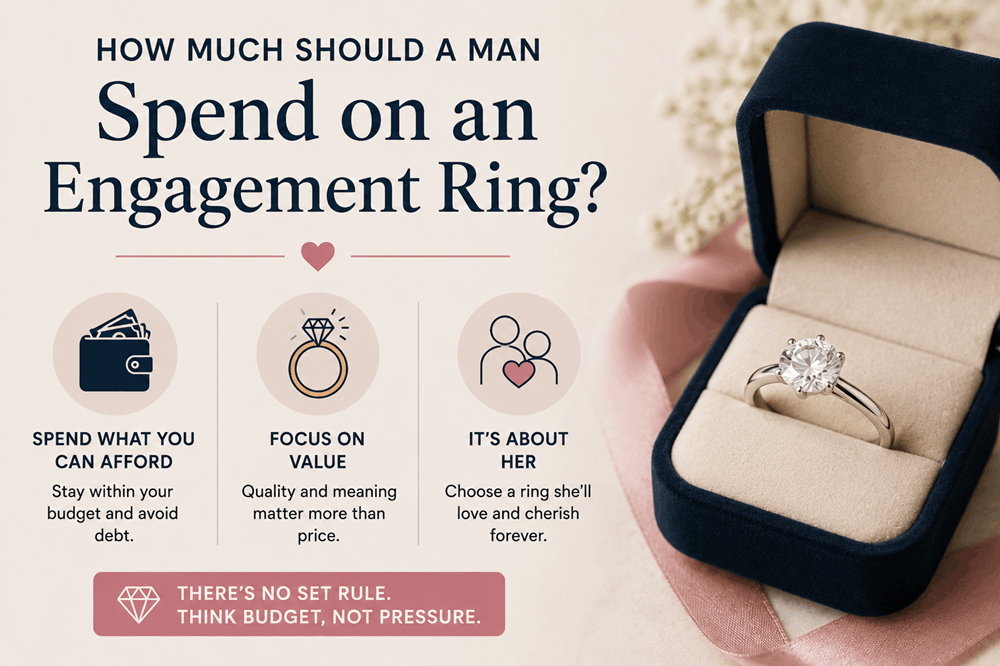
A man should spend only what he can comfortably afford on an engagement ring. There is no required salary formula, minimum price, or amount that proves how serious he is about marriage. For many buyers, a sensible budget may fall between $1,000 and $5,000, but spending less or more can be entirely appropriate.
The average engagement ring cost in the United States was approximately $4,600 in 2025, according to The Knot’s Jewelry and Engagement Study. BriteCo reported a higher average of $6,504 based on appraisal data from insured rings. The difference shows why an average should be treated as context rather than a personal spending target.
The right amount is one that purchases a ring the recipient will enjoy without draining emergency savings, creating high-interest debt, or delaying more important goals.
How Much Should You Spend at Different Income Levels?
Income can influence the budget, but it should never be the only factor. Debt, rent, savings, dependents, wedding plans, and job stability may matter more than the amount on a paycheck.
| Financial situation | Possible ring budget |
|---|---|
| Limited savings or high-interest debt | Under $1,500 |
| Stable income with some available savings | $1,500–$3,500 |
| Strong savings and manageable expenses | $3,500–$7,000 |
| High disposable income and established savings | $7,000 or more |
These are examples rather than rules. Someone earning a high salary may reasonably choose a $2,000 ring because the couple prefers to save for a home. Someone with a moderate income may comfortably spend $5,000 after saving specifically for the purchase.
The important comparison is not between your ring and someone else’s. It is between the ring price and your actual financial responsibilities.
Is the Three-Month Salary Rule Real?
No. A man does not need to spend three months of salary on an engagement ring.
The salary rule is a marketing idea, not a financial standard or etiquette requirement. It ignores taxes, student loans, credit-card balances, housing costs, healthcare expenses, childcare, emergency savings, and differences in local living costs.
Consider someone earning $60,000 a year. Three months of gross salary would equal $15,000. That amount might be manageable for someone with significant savings and few expenses, but financially damaging for another person earning exactly the same salary.
A ring should not be priced according to gross income alone. It should be priced according to what remains after real obligations and savings goals have been considered.
A Better Way to Calculate an Engagement Ring Budget
Instead of multiplying your salary by an arbitrary number, calculate what you can safely spend.
Step 1: Protect your emergency savings
Do not empty an emergency fund to purchase jewelry. Unexpected medical bills, repairs, job changes, and housing expenses will not disappear because you are preparing to propose.
If purchasing the ring would leave you unable to cover a basic emergency, reduce the budget or delay the purchase while you save.
Step 2: Review high-interest debt
Carrying expensive credit-card debt while financing an engagement ring can make the purchase cost far more than its original price.
For example, a $5,000 ring placed on a high-interest card may eventually cost hundreds or thousands of dollars more when only minimum payments are made.
Paying down costly debt first may allow you to shop with less stress and obtain better financing terms later.
Step 3: Consider upcoming wedding expenses
The ring is only one part of the engagement and wedding timeline. The couple may soon face costs involving:
- An engagement party
- Wedding deposits
- Wedding attire
- Photography
- Travel
- A honeymoon
- Moving expenses
- Wedding bands
Spending the entire available budget on the engagement ring may make every later decision more difficult.
Step 4: Set a monthly saving amount
Choose an amount you can save each month without missing bills or depending on credit.
If you can comfortably save $400 per month, six months of saving creates a $2,400 budget. Ten months creates a $4,000 budget.
This method connects the purchase to your actual finances rather than a general statistic.
Step 5: Add every purchase-related cost
Your total budget should include more than the advertised ring price.
Allow for:
- Sales tax
- Shipping
- Resizing
- Engraving
- Appraisal
- Insurance
- Future maintenance
A ring advertised for $4,000 may cost noticeably more after tax and optional services are added.
What Can You Get at Different Price Points?
Under $1,000
A budget below $1,000 can still provide a beautiful engagement ring.
Options may include:
- A smaller lab-grown diamond
- Moissanite
- Sapphire or another gemstone
- A simple gold setting
- A vintage or pre-owned ring
- A minimalist solitaire
At this level, focus on workmanship, durability, and a design the recipient genuinely likes.
$1,000 to $3,000
This range provides substantial flexibility. Buyers may find quality lab-grown diamonds, modest natural diamonds, moissanite center stones, gemstone rings, and classic settings in gold.
A carefully selected stone with strong cut quality can look more impressive than a larger stone chosen only for carat weight.
$3,000 to $5,000
This range is close to what many current buyers spend and offers a broad selection of stones, metals, and settings.
Possible choices include:
- A larger lab-grown diamond
- A smaller or mid-sized natural diamond
- A halo or three-stone setting
- A custom-designed ring
- A premium sapphire or other gemstone
$5,000 to $10,000
This budget can offer larger center stones, higher natural-diamond grades, platinum settings, intricate side stones, or established designer names.
However, a higher price does not guarantee that the recipient will prefer the ring. Personal style remains more important than the price tag.
Over $10,000
A five-figure budget may provide access to large natural diamonds, rare gemstones, luxury brands, detailed custom work, or unusually high grades.
Spend at this level only when the amount is genuinely affordable. Do not use a luxury purchase to compensate for uncertainty about the proposal or relationship.
Natural Diamond vs. Lab-Grown Diamond
The choice between natural and laboratory-grown diamonds can significantly change what a budget buys.
Lab-grown diamonds are diamonds created in controlled environments rather than formed naturally underground. They can offer substantially more size for the same amount of money, making them appealing to buyers who prioritize visible impact.
Natural diamonds may appeal to someone who values rarity, geological origin, tradition, or potential heirloom significance.
Before purchasing, make sure the seller clearly identifies whether a stone is natural, laboratory-grown, treated, or an imitation. The Federal Trade Commission advises shoppers to understand these distinctions and obtain important claims and return terms in writing.
Do not assume which option your partner prefers. Some people strongly want a natural diamond, while others would rather have a larger lab-grown stone or avoid diamonds entirely.
Should You Discuss the Budget With Your Partner?
In many relationships, yes.
The proposal can still be surprising even when the couple has discussed ring preferences and finances. In fact, involving the recipient may prevent an expensive mistake.
You can discuss:
- Natural or lab-grown stones
- Preferred shapes
- Metal color
- Approximate stone size
- Whether a gemstone is acceptable
- Comfort with financing
- How the ring fits into shared financial goals
The Knot’s research indicates that ring shopping has become increasingly collaborative, with many recipients participating in some part of the selection process.
If you want the ring itself to remain a surprise, ask the recipient to select several examples, create a private inspiration board, or visit a jeweler to determine general preferences.
Should You Finance an Engagement Ring?
Financing is not automatically a bad decision, but the terms matter.
A short zero-interest plan may be manageable when you already have the money available and can confidently complete the payments before the promotional period ends.
Financing becomes risky when:
- The interest rate is high.
- The payment depends on future overtime or bonuses.
- You already have significant consumer debt.
- The plan uses deferred interest.
- The monthly payment limits your ability to save.
- You are concentrating on the payment instead of the total price.
Buy-now-pay-later arrangements are still credit products, even when they are marketed as convenient installments. Review the full repayment amount, late fees, dispute procedures, and consequences of missing a payment before agreeing.
Never finance a more expensive ring merely because the monthly payment looks small.
How to Spend Less Without Making the Ring Look Cheap
Prioritize cut quality
A well-cut diamond reflects light effectively and can appear brighter than a larger stone with poor proportions.
Shop below full-carat milestones
A 0.90-carat stone may look very similar to a 1-carat stone while costing less. The same approach can work just below other popular weights.
Consider elongated shapes
Oval, pear, emerald, radiant, and marquise stones may appear larger because they cover more of the finger.
Choose an eye-clean clarity grade
You do not need a flawless diamond if inclusions cannot be seen without magnification.
Use yellow or rose gold strategically
Warmer metals can complement diamonds with slightly warmer color grades, potentially allowing you to spend less on color.
Select a simple setting
A clean solitaire can look timeless while placing more of the budget into the center stone.
Consider vintage and pre-owned rings
Estate jewelry may provide distinctive craftsmanship and value. Have the ring inspected and confirm the return policy before purchasing.
Compare the entire ring, not only the stone
Some advertised prices include only the setting or center stone. Ask for the complete price, including taxes and services, before comparing sellers.
What Matters More Than the Price?
A successful engagement ring should reflect the person who will wear it.
Pay attention to:
- Her usual jewelry style
- Preferred metal color
- Lifestyle and occupation
- Whether she likes subtle or bold designs
- Sentimental preferences
- Ethical or environmental priorities
- Comfort and durability
A $1,500 ring that perfectly matches her preferences may be far more meaningful than a $10,000 ring selected mainly to impress other people.
The recipient will wear the ring. Friends, relatives, social-media followers, and jewelry salespeople should not determine the budget.
Signs You May Be Spending Too Much
Reduce the budget when:
- You would need to empty your savings.
- You cannot pay normal bills comfortably.
- You are hiding the debt from your partner.
- You need a long high-interest loan.
- The purchase delays an urgent financial goal.
- You feel pressured by relatives or social media.
- You are choosing size over the recipient’s actual taste.
An engagement should begin with trust. Secret debt and financial anxiety are poor foundations for an otherwise joyful milestone.
Signs You May Be Spending Too Little
A modest budget is not automatically too low. However, reconsider the purchase when you are spending less only because you ignored the recipient’s clearly expressed preferences despite being able to afford them.
For example, choosing a delicate, poorly constructed ring that cannot withstand daily wear may create repair and replacement expenses later.
Spend enough to obtain:
- A secure setting
- A durable metal
- Accurate stone disclosure
- Acceptable workmanship
- A reasonable return policy
- A style the recipient wants
Value is not the same as choosing the lowest possible price.
Questions to Ask the Jeweler
- Does the quoted price include the center stone and setting?
- Is the stone natural, laboratory-grown, treated, or simulated?
- Does it have an independent grading report?
- Can the ring be resized?
- What is the return period?
- Are custom orders refundable?
- What does the warranty cover?
- Are regular inspections required?
- Does the jeweler provide cleaning or maintenance?
- What is the final cost after taxes and fees?
Compare several sellers and keep copies of receipts, grading reports, warranties, and written promises.
Frequently Asked Questions
Is $1,000 enough for an engagement ring?
Yes. A $1,000 budget can provide attractive lab-grown diamonds, moissanite, gemstones, vintage rings, and simple gold settings.
Is $3,000 a good engagement ring budget?
Yes. A $3,000 budget offers a broad selection and can purchase a well-made ring with a quality lab-grown diamond, modest natural diamond, or premium alternative gemstone.
Is $5,000 too much?
Not when it fits comfortably within your finances. It becomes too much when it requires harmful debt, drains emergency savings, or conflicts with shared priorities.
Should the ring cost more than the wedding band?
It often does because the engagement ring usually contains a center stone, but there is no requirement. Some couples spend more on durable wedding bands they intend to wear every day.
Who should pay for the engagement ring?
Traditionally, the person proposing pays. Modern couples may shop together, share the expense, use joint savings, or exchange rings.
Should you insure the ring?
Insurance is worth considering when replacing the ring after loss, theft, or damage would create financial hardship. Compare deductibles, exclusions, and replacement procedures.
Spend for Your Life, Not for Someone Else’s Expectations
A man should spend as much as he can comfortably afford on an engagement ring after accounting for debt, savings, bills, wedding costs, and shared goals.
The current U.S. average is useful as a point of comparison, but it is not a requirement. A thoughtful ring may cost $800, $3,000, $6,000, or considerably more.
Ignore the three-month salary rule. Set a total budget based on real money, learn what the recipient values, compare stones and settings carefully, and avoid financing that creates long-term stress.
The ring should represent the promise of a shared future. It should not make that future financially harder before the marriage has even begun.