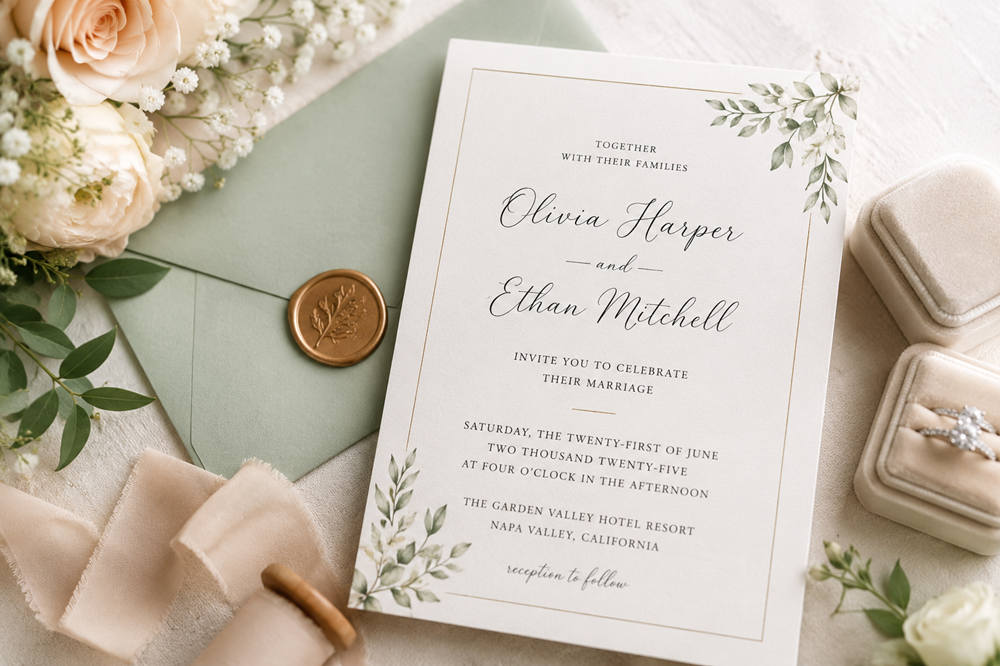
Whose Name Goes First on a Wedding Invitation? Etiquette Explained
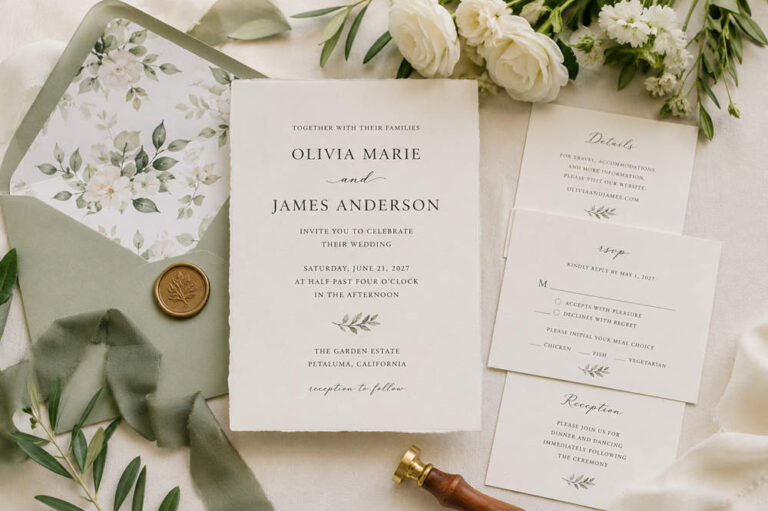
Traditionally, the bride’s name goes first on a wedding invitation, followed by the groom’s. Modern couples have more flexibility, however, and may arrange their names according to personal preference, alphabetical order, cultural tradition, or the invitation design.
Whose Name Goes First on a Wedding Invitation?
For a wedding with a bride and groom, traditional etiquette places the bride’s name first:
Elizabeth Bennett
and
Michael Carter
This remains a familiar choice for formal invitations, particularly when the bride’s parents are hosting. It is a convention rather than a requirement. Current wedding invitation etiquette allows couples to choose the order that sounds natural and suits their stationery.
Either partner may be listed first on a contemporary invitation. Couples may also use alphabetical order when they want a simple, neutral approach.
Why Does the Bride’s Name Traditionally Appear First?
The bride-first custom developed when her parents typically hosted the wedding and formally issued the invitation. Their names appeared at the top, followed by wording that introduced their daughter and then the groom.
A traditional invitation might read:
Mr. and Mrs. William Bennett
request the honour of your presence
at the marriage of their daughter
Elizabeth Anne
to
Mr. Michael James Carter
Elizabeth’s name comes first because she is being introduced as the hosts’ daughter. Her surname may be omitted because it has already been established through her parents’ names, while Michael’s full name identifies him separately.
This structure still works well for couples who want classic formal wedding invitation wording. Couples do not need to follow it when it does not reflect their family arrangement or preferred style.
The Difference Between the Host Line and the Couple’s Names
The host line and the couple line perform different jobs. Understanding the distinction prevents the order of the hosts from being confused with the order of the partners.
The Host Line
The host line identifies the people inviting guests to the wedding. It normally appears at the top of the invitation.
The hosts may be:
- One partner’s parents
- Both sets of parents
- The couple together with their families
- The couple themselves
- Other relatives who are hosting the celebration
The wording should reflect the actual situation. Parents who are formally hosting can be named, while shared support can be acknowledged with a phrase such as “Together with their families.”
The Couple Line
The couple line identifies the people getting married. It usually appears after the request line, although contemporary designs often place the names near the top as the main visual feature.
The order of the hosts does not automatically determine the order of the couple’s names. For example, the groom’s parents may be named first because they are issuing the invitation, while the bride can still appear first in the couple line under traditional etiquette.
Formal invitations often use full names or first and middle names. More relaxed designs may use first and last names or first names alone.
Name Order for Different Wedding Situations
Hosting arrangements affect how the invitation begins, but couples still have room to choose a name order that fits their circumstances.
When the Bride’s Parents Are Hosting
The traditional bride-first arrangement is usually the clearest choice when her parents are hosting:
Mr. and Mrs. Thomas Bennett
request the pleasure of your company
at the marriage of their daughter
Emily Rose
to
Jonathan Michael Reed
Emily’s surname is omitted because it is understood from her parents’ names. Jonathan’s surname remains because his parents have not been identified in the host line.
For a less formal invitation, both partners can use their full names:
Thomas and Rebecca Bennett
invite you to celebrate the marriage of
Emily Bennett and Jonathan Reed
When the Groom’s Parents Are Hosting
When the groom’s parents host, their names appear first because they are extending the invitation. Traditional etiquette can still place the bride first in the couple line:
Mr. and Mrs. Robert Reed
request the honour of your presence
at the marriage of
Emily Rose Bennett
to their son
Jonathan Michael Reed
A contemporary invitation may place Jonathan first, but that is a personal wording choice rather than a traditional requirement.
When Both Families Are Hosting
Both sets of parents can be named on a formal invitation:
Mr. and Mrs. Thomas Bennett
and
Mr. and Mrs. Robert Reed
request the pleasure of your company
at the marriage of their children
Emily Rose Bennett
and
Jonathan Michael Reed
When listing every parent would make the invitation feel crowded, a shared host line offers a cleaner alternative:
Together with their families
Emily Bennett and Jonathan Reed
invite you to celebrate their marriage
The order of the couple’s names can follow tradition or their established preference.
When the Couple Is Hosting
A self-hosting couple does not need a separate parent host line. Their names can open the invitation:
Sophia Martinez and Daniel Kim
invite you to join them
as they celebrate their marriage
Without a family-based structure, the couple may choose the order that sounds better when read aloud or creates the most balanced layout.
For Same-Sex Couples and Couples With Nonbinary Partners
When the bride-first convention does not apply, alphabetical order is a straightforward option:
Alex Morgan
and
Jordan Taylor
Alphabetical order is not mandatory. The couple can instead use the sequence in which they normally say their names, the order that feels personally meaningful, or the arrangement that works best with the typography.
A current wedding invitation wording guide similarly notes that couples of the same gender may arrange their names alphabetically or according to whichever order sounds best.
When families are named as hosts, their order can follow the couple’s order. If Alex appears first in the couple line, Alex’s family can appear first in the host line for a clear and balanced arrangement.
Can the Groom’s or Second Partner’s Name Go First?
Yes. A couple may intentionally place the groom or another partner first because of cultural convention, alphabetical order, personal preference, or the visual design of the invitation.
Some name combinations simply sound better in one sequence. A long name may also fit more naturally above a shorter one in a centered layout. These practical considerations are valid, especially when the invitation uses modern rather than strictly traditional wording.
The couple does not need to defend its choice. Both partners should simply agree on the order before the stationery is printed.
Keep the Name Order Consistent
Once an order has been chosen, using it across the main wedding materials can make the celebration feel more coordinated. The same sequence may appear on:
- Save-the-dates
- The wedding invitation
- The wedding website
- Ceremony programs
- Welcome signs
- Personalized reception signage
The layout does not need to remain identical. Names might appear side by side on the invitation and stacked on a narrow program, but retaining the same order creates a sense of continuity.
This advice applies to the couple’s own names. The order used when addressing guests on invitation envelopes follows separate etiquette based on each recipient’s preferred name and title.
Final Takeaway
The bride’s name traditionally appears first on a wedding invitation, but either partner may be listed first today. The best order should reflect the invitation’s level of formality, the hosting arrangement, the couple’s preferences, and the way the names look and sound together.