
What Is a Mixer Event? What to Expect and How It Works
A mixer event is a gathering designed to help people meet and talk with others they may not already know. Mixers can be professional, social, educational, or community-based, but conversation is usually the main activity.
The word “mixer” describes how guests interact, not how formal the occasion is. One mixer might be a casual afternoon at a neighborhood café, while another could be an evening reception with cocktail attire.
What Is a Mixer Event?
A mixer is an event where guests are encouraged to circulate, introduce themselves, and form new connections. Rather than following a long program or remaining in assigned seats, attendees usually move between small conversation groups.
Some mixers have a specific goal. A business association may organize one to connect local professionals, a university may welcome new students with a campus mixer, or a community group may invite residents to meet their neighbors. Others are simply intended to help people socialize around a shared interest.
A mixer may include refreshments, music, conversation prompts, or a brief welcome from the host. These elements support the event, but they do not replace its central purpose: giving people an easy setting in which to meet.
What Happens at a Mixer Event?
Most mixers have a loose structure rather than a detailed schedule. Guests arrive, check in if necessary, find something to drink, and begin talking. The host may offer a short introduction before opening the event for general mingling.
Arrival and Introductions
Depending on the event, guests may show a ticket, sign in, or receive a name tag. Professional mixers sometimes include a company, job title, or industry on the tag, while social events may use first names only.
Hosts or volunteers are often positioned near the entrance to welcome arrivals and direct them into the room. They may also make an initial introduction when someone arrives alone.
Informal Conversation and Mingling
Guests generally speak in small groups that change throughout the event. A conversation may begin with a simple question about the venue, the host organization, or the reason for attending.
At a professional mixer, people may discuss their work, current projects, or industry interests. At a social or community event, conversations are more likely to center on hobbies, local activities, mutual acquaintances, or shared experiences.
No one is expected to speak with every person in the room. The aim is usually to have a few enjoyable or useful conversations rather than collect as many introductions as possible.
Food, Drinks, and Light Activities
Mixers often include food and drinks that can be enjoyed while standing. Small appetizers, desserts, coffee, sparkling water, wine, or cocktails are common, depending on the time, venue, and audience.
A host may add a simple icebreaker, conversation card, prize drawing, or group activity. These features are most effective when they make introductions easier without occupying the entire event.
Brief Announcements
A company, school, nonprofit, or membership organization may include a short welcome or announcement. The speaker might introduce the host organization, recognize a guest, or mention an upcoming program.
These remarks are usually brief because attendees expect most of the event to be available for conversation.
Common Types of Mixer Events
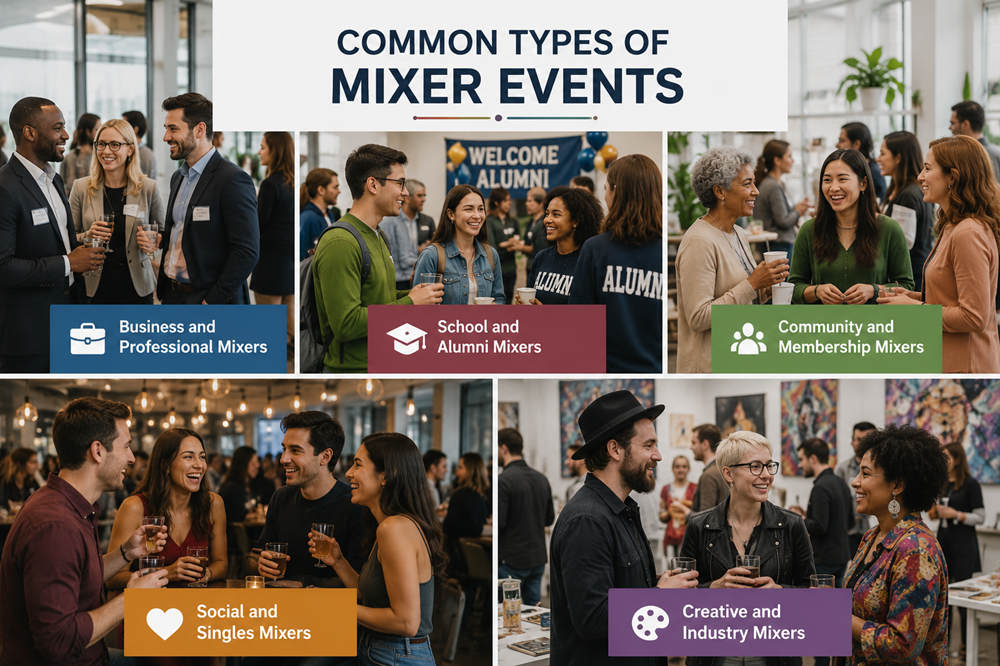
Mixers can be organized for many different audiences. The invitation should make clear who is attending and what brings the group together.
Business and Professional Mixers
Professional mixers bring together business owners, employees, entrepreneurs, potential clients, or people working in related fields. They are commonly hosted by companies, industry groups, coworking spaces, conference organizers, and chambers of commerce.
The mood is often more relaxed than a meeting or career fair. Guests may exchange contact details and discuss their work, but the event usually allows room for ordinary social conversation as well.
School and Alumni Mixers
Schools and universities may hold mixers for incoming students, graduates, faculty members, families, or alumni. A new-student mixer can help classmates become familiar with one another, while an alumni event may reconnect people from different graduating years.
Some school mixers also have a career element, bringing students together with alumni or employers who can offer insight into particular professions.
Community and Membership Mixers
Neighborhood associations, volunteer groups, nonprofits, clubs, and membership organizations use mixers to strengthen relationships among people connected to the same community.
These events may welcome new members, introduce volunteers to staff, or give residents an informal opportunity to meet before working together on future activities.
Social and Singles Mixers
Social mixers are organized primarily to help guests make friends or expand their social circles. They may be based on age, location, lifestyle, or a shared interest such as books, travel, food, or sports.
A singles mixer is specifically intended for people open to dating. Unlike speed dating, it usually allows guests to choose their own conversations and move around at their own pace.
Creative and Industry Mixers
Creative mixers bring together people such as artists, writers, musicians, designers, filmmakers, performers, and event professionals. They offer an informal place to exchange ideas, discover one another’s work, and meet possible collaborators.
Displays, demonstrations, or short performances may be included, giving attendees a natural subject with which to begin a conversation.
What Should You Wear to a Mixer Event?
A mixer does not have one standard dress code. The invitation, venue, host, time of day, and purpose of the event should guide your choice.
When no dress code is listed, consider what guests would normally wear in that particular setting. Clothing should be polished enough for meeting new people but comfortable enough for standing and moving around.
Professional Mixers
Business casual is appropriate for many professional mixers. Possible outfits include tailored trousers with a blouse or button-down shirt, a simple dress, a blazer, loafers, flats, or polished low heels.
The industry still matters. A mixer hosted by a law or finance organization may be more formal than one for technology workers, artists, or independent creatives. When uncertain, dressing slightly more neatly than usual is generally safer than arriving too casually.
Casual or Community Mixers
Smart casual clothing usually works for neighborhood, club, volunteer, or daytime social events. Clean jeans, casual dresses, sweaters, polo shirts, comfortable trousers, and simple shoes may all be suitable.
Outdoor venues and activity-based mixers may call for more practical footwear or weather-appropriate layers.
Evening and Cocktail-Style Mixers
An evening event at a hotel, gallery, restaurant, or rooftop venue may have a more polished atmosphere. A cocktail dress, jumpsuit, tailored separates, or a suit without a tie may fit the occasion.
Look at both the venue and the invitation language. An evening mixer is not automatically formal, even when drinks are served.
What Should You Bring?
Most mixer events require only a few essentials. Bring any ticket, confirmation email, or identification mentioned in the invitation. A charged phone is also useful for checking event details and saving contact information.
Business cards can be convenient at professional mixers, although many attendees now exchange details digitally. A résumé is usually unnecessary unless the event is specifically described as a recruiting mixer, career fair, or hiring event.
Gifts are not normally expected. An exception may be a small mixer held in someone’s home, where an ordinary host gift could be appropriate.
After a professional mixer, consider following up with a new contact when you had a meaningful conversation or agreed to share information. A brief message that refers to what you discussed is more useful than sending a generic note to everyone you met.
How to Host a Successful Mixer
A successful mixer feels natural, but it still needs a clear purpose, a suitable setting, and enough organization to prevent guests from feeling lost.
Choose a Clear Purpose and Guest Group
Begin by deciding why the event is being held and whom it is meant to connect. A mixer might welcome new members, introduce local vendors, connect professionals in the same industry, or bring neighbors together.
The invitation should state the intended audience, date, location, dress code, cost, and registration requirements. It should also mention whether refreshments will be provided.
Use a Venue That Encourages Movement
Choose a room with enough open space for guests to circulate. A combination of standing areas and limited seating works well because attendees can move easily while still having places to rest.
Keep background music at a level that creates atmosphere without making conversation difficult. Clear signs should direct guests to check-in, refreshments, restrooms, and any scheduled activities.
Keep Refreshments Simple
Serve food that is easy to handle while standing, such as small appetizers or bite-sized desserts. Water and nonalcoholic choices should remain available even when the event also offers beer, wine, or cocktails.
The menu does not need to be elaborate. Convenient service and short lines matter more than offering a large number of dishes.
Use Activities Sparingly
One simple prompt or icebreaker can help the room become comfortable, especially when few attendees know each other. Useful networking activities encourage people to begin talking or move beyond their existing groups.
Avoid filling the schedule with compulsory games. Guests need open time to continue conversations that develop naturally.
Make Thoughtful Introductions
Hosts should welcome guests as they arrive and watch for anyone standing alone. When introducing two people, mention a genuine point of connection, such as a shared profession, neighborhood, interest, or project.
This small amount of context gives both people an immediate subject to discuss and is often more helpful than a complicated activity.
What Makes a Mixer Enjoyable?
A good mixer gives guests a clear reason to attend and enough freedom to decide how they spend their time. The room is comfortable, the purpose is easy to understand, and the host helps conversations begin without forcing them.
For attendees, the simplest approach is to read the invitation carefully, dress for the setting, and arrive prepared to introduce yourself. Most of the event will consist of informal conversation, and a few genuine connections are enough to make the experience worthwhile.