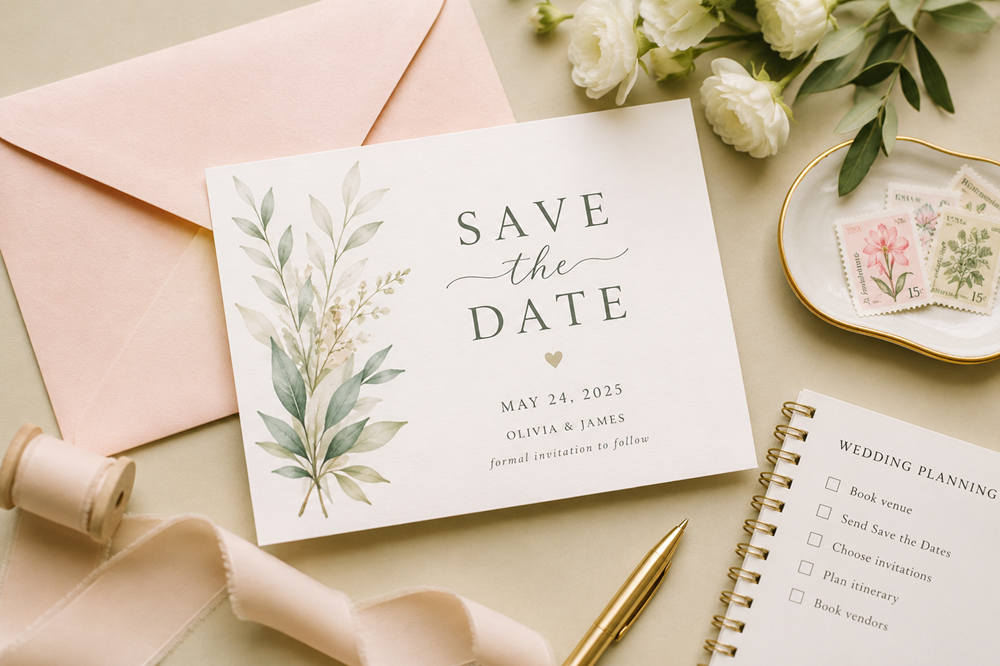
When to Send Save the Dates: A Simple Wedding Timeline
For most weddings, send save the dates about six to eight months before the wedding. If you are planning a destination wedding or many guests will need to travel, sending them eight to twelve months ahead can be more helpful.
Think of those numbers as a practical guide rather than a strict etiquette rule. The best timing depends on how much advance planning your guests will need—and whether your wedding date is firmly settled.
When Should You Send Save the Dates?
Six to eight months before the wedding is a comfortable rule of thumb for most couples. It gives guests time to mark their calendars while keeping the wedding close enough that they can begin making realistic plans.
Etiquette guides vary slightly on the exact window. Some recommend starting around four to six months for a local wedding, while others suggest six to nine months. There is no need to worry about choosing the one perfectly correct month. What matters is giving your guests useful notice.
| Wedding situation | When to send save the dates |
|---|---|
| Most local weddings | About 6–8 months before |
| Many guests traveling | About 8–10 months before |
| Destination wedding | About 8–12 months before |
| Holiday or high-demand weekend | Lean toward the earlier end |
| Short engagement | Send promptly, or skip them if invitations will follow soon |
Before sending your cards, make sure the date is dependable. You do not need to have every wedding detail finalized, but guests should be able to confidently reserve that day.
When to Send Save the Dates for a Destination Wedding
Destination weddings usually need more notice. Aim for roughly eight to twelve months before the wedding, especially when guests will need to book flights or arrange an international trip.
The extra time gives guests a chance to decide whether the trip works for their budget and schedule before the best travel and lodging options become limited. Current destination wedding etiquette guidance similarly recommends an eight-to-twelve-month window for save the dates.
If the trip is particularly complicated, there is nothing wrong with leaning toward twelve months. A wedding requiring international flights, several nights away, or limited local accommodations asks more of a guest than a celebration close to home.
You also do not need every itinerary detail ready before announcing the date. Once the date and general destination are reliable, your wedding website can hold travel information, hotel details, and updates as they become available.
When Does It Make Sense to Send Them Earlier?
Travel is not the only reason to give guests extra notice. The calendar itself can make an earlier save the date useful.
Consider sending yours toward the earlier end of the range if:
- Your wedding is on a holiday or holiday weekend.
- The date falls during a popular vacation season.
- Most of your guest list lives outside the area.
- Hotels near the venue are limited or tend to fill quickly.
- Your wedding weekend includes events across several days.
- Many guests are likely to need substantial advance notice for time off.
For example, a Saturday wedding near home may be easy for most guests to fit into their calendars. The same wedding date in a popular beach town over a holiday weekend may require reservations months earlier. Let the actual demands of attending guide your timing.
Can You Send Save the Dates Too Early?
Yes. More notice is not always more useful.
Wait until your wedding date and general location are firm enough that you do not expect them to change. If your venue determines your wedding date, confirming that booking first is the safer choice.
You usually do not need to send save the dates more than a year ahead. When an event is still very far away, guests may not be able to book travel or request time off yet, and the announcement can be easier to put aside and forget.
The goal is to send the card when guests can actually do something with the information—not simply as early as possible.
What If You Are Late Sending Save the Dates?
If the six-to-eight-month mark has already passed, you have not ruined anything. Send the save the dates once your plans and guest list are ready rather than delaying them because you missed an ideal window.
Even a few months of advance notice can be useful, particularly for guests who need to arrange their schedules.
With a short engagement, however, there may come a point when sending a save the date followed almost immediately by a formal invitation no longer makes much sense. If your invitations are already close to being mailed, you can simply move ahead with them instead.
You may also want to personally give close family members or important out-of-town guests an early heads-up once the date is confirmed.
The goal is communication, not completing a ceremonial checklist.
Who Should Receive a Save the Date?
Send a save the date only to someone you are certain will be invited to the wedding. Once you ask a guest to reserve the day, the natural expectation is that a formal invitation will follow.
That means it is better to wait on tentative guests. If your final head count depends on budget, venue capacity, or responses from other people, do not use save the dates to announce the wedding to everyone on a preliminary list.
The way you address the card can also help clarify who is included. For a couple or family invited together, addressing the save the date accordingly can prevent uncertainty without requiring a long explanation on the card itself.
Do Digital Save the Dates Follow the Same Timeline?
Yes. Guests need roughly the same amount of notice whether your save the date arrives on paper or by email.
The main advantage of a digital version is speed. If you are working with a shorter planning timeline, you can send it as soon as your information is ready instead of allowing extra time for printing and mailing.
The format may change, but the purpose does not: give invited guests enough notice to reserve the day.
Save the Dates vs. Wedding Invitations
A save the date is an early announcement. It gives guests the wedding date and usually the general location so they can put the celebration on their calendars.
The wedding invitation comes later. It formally invites the guest and provides the information needed to respond and attend, such as ceremony details and RSVP instructions.
The basic stationery timeline looks like this:
Set the date → Send save the dates → Finalize wedding details → Send invitations → Collect RSVPs → Wedding day
Everyone who receives a save the date should still receive a formal invitation. The earlier card is advance notice, not the invitation itself.
A Simple Rule for Choosing Your Send Date
If you want one easy rule to remember, start with six to eight months before the wedding. Then ask one question: Will attending our wedding require significantly more advance planning than usual?
If the answer is yes, move earlier. Destination weddings, holiday weekends, limited accommodations, and guest lists filled with travelers can all justify additional notice.
If your timeline is shorter, send the information when it is ready rather than worrying about missing an etiquette deadline. A save the date is meant to make things easier for your guests. Once the wedding date is firm and your guest list is settled, choose the timing that gives the people you love a realistic chance to plan for the celebration.