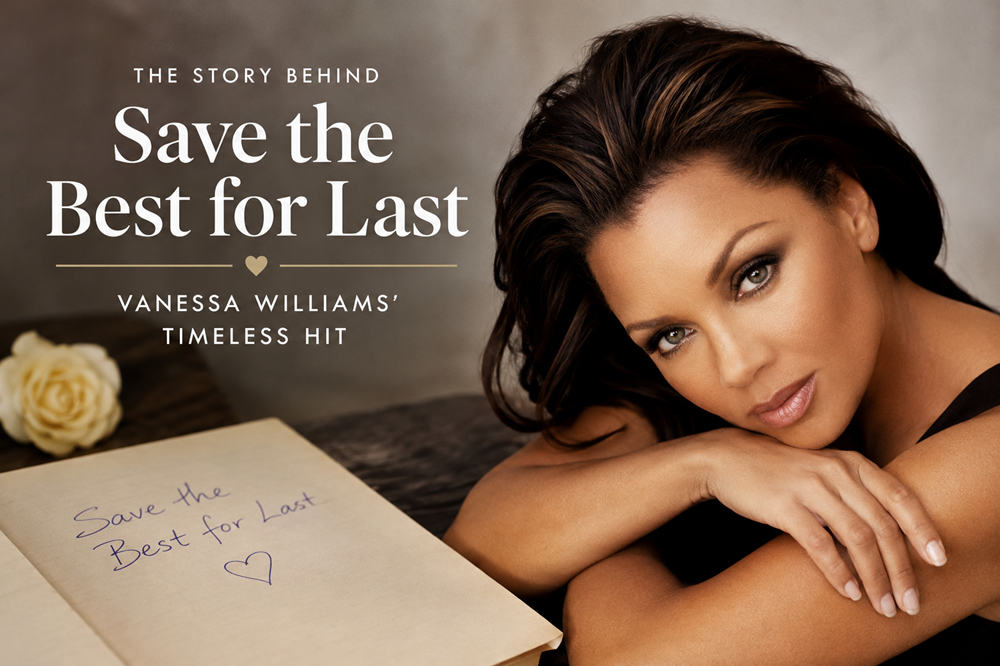
Save the Best for Last Meaning: The Story Behind Vanessa Williams’ Hit
“Save the best for last” means keeping the most enjoyable, impressive, or meaningful part until the end. It is also the title of Vanessa Williams’ 1992 No. 1 hit, which turns the familiar expression into a romantic story about getting what you wanted only after it seemed the opportunity had passed.
The song became the biggest pop hit of Williams’ career, but its path to her was far from straightforward. Its writers changed the original emotional direction of the song, several artists reportedly passed on the demo, and Williams ultimately recorded the version that became a defining early-1990s ballad.
What Does “Save the Best for Last” Mean?
To “save the best for last” means deliberately leaving the most enjoyable, valuable, exciting, or anticipated part of an experience until the end.
The phrase usually carries a positive sense of anticipation. Instead of experiencing the highlight immediately, you hold it back so that the experience finishes on a particularly satisfying note.
Vanessa Williams’ song gives the expression a different twist. The “best” thing arrives late not because anyone carefully planned it that way, but because a relationship develops only after the narrator has spent time believing that the person she loves is interested in someone else.
What Is Vanessa Williams’ “Save the Best for Last” About?
“Save the Best for Last” tells the story of romantic feelings that are finally returned after a long period of uncertainty.
The narrator has cared for someone who has been searching elsewhere for love. She remains close to him while watching him pursue relationships with other people, making it seem unlikely that the connection she wants will ever happen.
Then the situation changes. The person who once looked elsewhere begins to see her differently, creating the emotional reversal at the center of the song.
That makes “Save the Best for Last” a song about more than simply falling in love. It is also about timing. The relationship does not develop when the narrator first wants it to, and the eventual change feels surprising precisely because disappointment came first.
The familiar title neatly captures that turn. What appears to have arrived too late instead becomes the most meaningful part of the story.
How “Save the Best for Last” Was Written
“Save the Best for Last” was written by Phil Galdston, Wendy Waldman, and Jon Lind.
In a detailed account of the songwriting process, the writers recalled that Galdston and Lind began developing the song in Los Angeles in March 1989. Galdston started playing the main musical theme on a keyboard, Lind worked on the melody, and Galdston came up with the title during the session.
Galdston then brought the developing song to Waldman in Nashville. Her reaction helped reshape the entire lyric.
The Original Idea Was Much Darker
The gentle romantic song listeners know today was not the writers’ first concept.
Waldman recalled that she loved the music but found the original lyrical idea unexpectedly bitter and ironic. To her, the emotional direction did not fit the beauty of the melody.
The writers agreed to change course. Instead of using “save the best for last” sarcastically, they developed a positive interpretation in which an unexpected romantic outcome becomes the emotional payoff.
After Waldman and Galdston completed the lyric, the three writers reunited in Los Angeles to record a relatively simple demo, with Waldman singing the vocal. That demo eventually began making its way to artists and record executives.
The change in direction proved important. The finished song balances disappointment with optimism rather than making either feeling dominate the entire story.
Who Was Offered the Song Before Vanessa Williams?
The exact route “Save the Best for Last” took before reaching Vanessa Williams is somewhat unclear because accounts given at different times do not match perfectly.
In their 2013 interview, Galdston, Waldman, and Lind said the completed demo was pitched to three high-profile artists, all of whom passed. They did not name those performers. The writers said publishing executive John Anderson later played the demo for Mercury Records president Ed Eckstine, who liked it and brought it to Williams.
Williams added another version of the story in August 2026. During an appearance on Jesse Tyler Ferguson’s Dinner’s on Me podcast, she said the song had first been offered to Bette Midler and then Barbra Streisand before reaching her. Williams described herself as the third singer in line for the song.
The two recollections differ slightly in the number of artists involved, so it is safest not to treat either as a complete list of everyone who may have considered the demo. What they agree on is the larger point: the song was passed over before Williams recorded it.
Williams’ more recent account, including the Midler and Streisand connection, was reported by Entertainment Weekly.
In hindsight, there is an appealing coincidence in that history. A song called “Save the Best for Last” became a career-defining hit for an artist who received it only after others had turned it down.
How Successful Was “Save the Best for Last”?
Williams included “Save the Best for Last” on her second studio album, The Comfort Zone. Released as a single in February 1992, the ballad became her biggest hit on the Billboard Hot 100, spending five weeks at No. 1.
The song also performed strongly internationally. In the United Kingdom, it reached No. 3 and spent 11 weeks on the Official Singles Chart, according to the Official Charts Company.
Its success brought major awards recognition as well. At the 35th Annual Grammy Awards, Williams’ recording was nominated for Record of the Year and Female Pop Vocal Performance. Songwriters Phil Galdston, Jon Lind, and Wendy Waldman also received a Song of the Year nomination for the composition.
The Recording Academy’s 1993 awards record places the song alongside some of the biggest recordings of the period.
Why the Song Still Works
“Save the Best for Last” has a simple structure at its heart: expectations are established and then reversed.
That makes the story easy to understand without requiring an elaborate narrative. The listener knows what the narrator wants, recognizes why she believes she may not get it, and then experiences the surprise when the relationship changes.
The title helps enormously. “Save the best for last” was already a recognizable expression, so the song begins with an idea listeners can understand before placing it in a romantic setting.
Its relatively restrained presentation also gives the emotion room to develop. Rather than depending entirely on a huge dramatic climax, the song draws much of its impact from the contrast between uncertainty and eventual fulfillment.
That combination of a memorable title, a clear emotional reversal, and a gentle pop arrangement helps explain why the recording remains closely associated with Williams decades after its release.
How Is “Save the Best for Last” Used as an Expression?
Outside the song, “save the best for last” remains a common expression and does not necessarily have anything to do with romance or Vanessa Williams.
It can describe many everyday situations:
- Food: Someone might leave a favorite bite or dessert until the end of a meal.
- Gifts: The most anticipated present might be opened after all the others.
- Performances: An organizer may place a particularly popular act near the end of a show.
- Announcements: A speaker can hold back the biggest piece of news until the conclusion.
- Stories: A writer or storyteller may reveal the most surprising detail near the end.
- Events: A special guest, activity, or surprise can be reserved as the final highlight.
In all of these cases, the expression suggests ending with something worth anticipating. Williams’ song uses the same basic idea more figuratively, turning the “best” part into an unexpected romantic outcome.